The Decisive Stage of the War. When Could Hostilities Cease?
According to many assessments, Russia’s war against Ukraine may soon reach a decisive phase. Furthermore, based on a number of indicators, active hostilities could end as early as this autumn. However, it cannot be ruled out that the war could continue into 2027. The main factor that could bring it to a halt in the near future is Russia’s military weakening due to its economic crisis and the improvement of Ukraine’s combat capabilities thanks to consolidated Western aid. Given this dynamics, the situation will be most unfavorable for Russia and most favorable for Ukraine in September–October. It is then that it will become clear whether the war will end during this period or continue beyond it.
In the view of many politicians and experts, Russia’s war against Ukraine is approaching its final stage – at least in the form in which it is currently being waged. And its future prospects will be determined as early as this coming autumn. We’ve discussed similar assessments in our previous articles, based on an analysis of the purely military, economic, and political aspects of the war. Those articles, along with research by other experts, contain a wide range of indicators and facts that help us understand what is happening. They fairly accurately reflect the trends that are shaping the conditions for qualitative changes in the situation surrounding the Russian-Ukrainian war. It is also possible to identify key signs that such transformations are already on the horizon. This is further evidenced by factors from which relevant conclusions can be drawn. First and foremost, these relate to the situation on the front lines and the economic capabilities of the parties.
Indeed, Russia and Ukraine have effectively reached a stalemate in ground combat operations. The front line has essentially stalled with only minor shifts, and Ukraine is recapturing more territory than Russia is seizing. Due to the widespread use of UAVs on the battlefield, it is practically impossible to achieve significant changes on the ground, even if Russia were to declare a mobilization. Therefore, the air component will be decisive.
Currently, Ukraine holds the advantage in UAVs – including short-, medium-, and long-range models. However, Russia still dominates in missile capabilities, particularly with regard to ballistic missiles. It is these that are causing Ukraine the most trouble. But by early autumn, Ukraine will acquire ballistic missiles of its own, and eventually it will be able to scale up their production. This will have a significant impact on the situation. The Defense Forces of Ukraine (DFU) will be able to destroy Russian production facilities for ballistic and cruise missiles, as well as air defense systems, fairly quickly. The locations of those production facilities are known. There are not many of them, and they are all within our reach. As for ballistic missiles, they are extremely difficult to shoot down – especially given that Russia cannot provide dense air defense coverage across its entire territory.
It will take Ukraine no more than a month to accomplish this task. Therefore, it could achieve strategic air superiority as early as October of this year. This will make it possible to completely destroy the Russian oil industry and move on to destroying the gas and electric power sectors. Along with them, other defense industry enterprises, warehouses, and transportation infrastructure facilities will also be destroyed. This is all the more so because, in addition to ballistic missiles, UAVs will be used – and Ukraine has an ever-increasing number of them. It is clear that Ukraine will not be able to destroy the entire Russian economy. But that is not necessary. It is enough simply to inflict critical damage on certain key sectors, which will plunge the Russian Federation into chaos. As a result, Russia will be unable to continue the war. This is precisely what Ukraine is doing right now – and quite successfully.
Against this background, Russia is already entering an acute phase of economic crisis. The reasons for and manifestations of this crisis are well known and require no further elaboration. Crisis processes are rapidly spreading across the RF, and Ukraine’s strikes against the Russian economy are accelerating them. At the latest by mid-autumn of this year, the economic situation in Russia will deteriorate sharply and become significantly worse than it was following the collapse of the USSR.
Russian businesses are well aware of this, particularly the political-oligarchic circles close to the Kremlin, which have begun withdrawing their capital from Russia en masse. The result – and evidence of this – was a record plunge in the Russian stock market in July of this year, which exceeded the declines seen during the global financial and economic crisis of 2008–2009 and the COVID-19 pandemic, which brought a significant portion of the global and Russian economies to a standstill. Many ordinary Russians are beginning to realize this as well, rushing to withdraw their savings from banks, close accounts, and convert their funds into cash. Since the beginning of this year, Russian citizens have withdrawn more than three trillion rubles from the banking system. Moreover, they are not deterred by the relatively high interest rates on deposits, which stand at 16%. So far, the volume of funds withdrawn remains comparatively modest, as the total amount of savings in banks exceeds 60 trillion rubles. But the process has only just begun and is gaining momentum. According to independent financial experts’ forecasts, the acute phase of the financial crisis in Russia will occur in mid-autumn. By all known criteria, it has already begun. Indeed, at least 20% of bank loans are already in default.
But then, the Russian government is already losing its ability to finance the war. Currently, budget expenditures are twice as high as budget revenues. The government cannot cover the deficit even through domestic borrowing, which had been its sole source of funding. There is virtually no possibility of raising taxes, increasing financial reserves, or boosting the potential for oil price growth. Under these circumstances, banks and other investors have stopped purchasing government bonds. Consequently, trading in these bonds at exchange auctions was suspended on July 20 of this year. No resumption is expected in the near future. Therefore, as early as next autumn, the RF’s budget deficit will rise to a level that can be considered unacceptable.
In the USA, there is already a growing conviction that Ukraine is beginning to win the war, while Russia is losing the ability to continue it. President D. Trump, who always sides with the winner, has publicly recognized Ukraine as such. He has stopped pressuring our country to agree to Russia’s terms for ending the war and plans to expand arms supplies to us, albeit using European funds. At the same time, D. Trump has agreed to adopt the so-called “hellish sanctions” against Russia, drafted by US Senator Lindsey Graham. After some final revisions, they could be implemented in August of this year and have a devastating impact on Russia’s economy as early as this autumn.
As for restoring peace in Ukraine – even if only temporarily – this takes on special significance for D. Trump in light of the upcoming US congressional elections in November of this year. A ceasefire in the Russian-Ukrainian war – given Ukraine’s stance – and, even more so, a Ukrainian victory with the USA’s support would significantly boost D. Trump’s approval ratings, as the majority of Americans support our country. This fact is one of the most powerful factors influencing Russia’s war against Ukraine. Lindsey Graham’s sanctions could force the entire world to choose between the USA and Russia. This would also apply to China, as the RF’s main pillar of support in its war against Ukraine.
China is watching all of this unfold and has already publicly distanced itself from Putin and the Putin regime. As is well known, this occurred during Putin’s visit to Beijing in May 2026 and took the form of a public humiliation. For instance, the Chinese side accompanied the official dinner attended by Chinese President Xi Jinping and Putin with music from the ballet “Swan Lake”, which was typically broadcast on Soviet television on the days when the deaths of Soviet leaders were announced… Beijing then began establishing contacts with representatives of the second tier of the Russian government. It is precisely these figures who may rise to power after the fall of Putin’s regime. China will certainly not help him in any way.
NATO leaders, the EU, and leading European countries – which have managed to unite with the United States – have taken a clear and unequivocal position on support of Ukraine. This was demonstrated at the G7 summit in June of this year. Its main outcome was the decision to conduct a joint operation with Ukraine to compel Russia to make peace. Currently, as part of this operation, Ukraine is striking critical targets in Russia’s oil and other infrastructure, while Europe and the USA are financing and supplying our country with UAVs. The operation is scheduled to last until mid-August of this year.
All of the processes just mentioned are irreversible in nature, although Russia is still trying to slow them down and achieve at least minimal success in the war. This refers to taking control of the entire territory of the Donbas, which would allow Russia to declare that it has “achieved the objectives of its special military operation”.
This is precisely where Russia is currently focusing all its efforts, even at the expense of other fronts. At the same time, airstrikes on key elements of Ukraine’s military, military-industrial, economic, energy, transportation, and logistical infrastructure are intensifying. These actions are also accompanied by acts of terror against the civilian Ukrainian population. In this way, Russia is attempting to seize the entire Donbas by force and undermine Ukraine’s continued resistance. How this is happening is also well known, so we will not go into detail on this issue. There is nothing new here, except that the Russians are going “all in”. Since the beginning of July this year, Russia has been using nearly twice as many ballistic missiles to strike Ukraine as it is capable of producing. In the first three weeks of July, 107 such missiles were launched, while their monthly production is about 60 units. In other words, Russia has begun using its stockpiles without worrying about replenishing them. It evidently hopes that, starting in the autumn and beyond, such missiles will no longer be needed in large quantities. Besides, missiles from the S-400 air defense system were used for the first time to strike Kyiv.
Another telling fact was Russia’s 30% increase in military spending in the second quarter of this year. Rising global oil prices would not have allowed it to do so, as the additional funds were primarily directed toward covering the state budget deficit. Therefore, Moscow could only increase war spending by diverting funds originally earmarked for military needs in the second half of this year – more specifically, in the fourth quarter – since the war is continuing with even greater intensity in the third quarter.
All these facts indicate that, under pressure from its economic and other problems, Russia is already being forced to consider suspending the war no later than mid-autumn of this year. Because then it will have neither the economic, financial, military, nor human resources to continue hostilities. Therefore, Russia will do its best to achieve its objectives regarding Ukraine to the greatest extent possible by October of this year. In July–September of this year, we should expect Russian troops to maintain a high level of offensive activity on the front lines. These efforts will even intensify with the aim of capturing the Sloviansk-Kramatorsk metropolitan area. At the same time, the intensity of missile and drone strikes against Ukraine will also increase. These Russian efforts will be supported by other actions, including covert operations. For instance, there may be assassination attempts against Ukraine’s leadership and even against pro-Ukrainian politicians in the USA and Europe. Questions have arisen regarding the reason for the sudden death of US Senator Lindsey Graham in July of this year, following his visit to Ukraine. After all, his positions were unequivocally pro-Ukrainian; he exerted influence on D. Trump in a manner that was positive for Ukraine and negative for Russia; and he was a key architect of anti-Russian sanctions.
At the same time, Russia will inevitably seek to provoke internal divisions and confrontation in Ukraine. Recently, it has attempted to achieve this by exploiting disagreements on certain issues between the leadership of the Ministry of Defense and the Armed Forces of Ukraine. And although this was, as they say, a natural part of our government’s routine, Russia will continue to act in this direction and through other forms of propaganda – including with the aim of discrediting Ukraine on the international stage.
Russia will also intensify negative activities aimed at undermining NATO and EU unity regarding Ukraine through “hybrid warfare” tactics. This primarily refers to an increase in support in Europe for pro-Russian, Euroskeptic, and nationalist forces. Special attention will be paid to Slovakia and Bulgaria, where pro-Russian political forces have come to power. As a result, Bulgaria has already withdrawn from the Coalition of the Willing, a move that was clearly made under Russian influence. Besides, Russia is actively stirring up yet another scandal between Ukraine and Poland based on historical events. Recently, the Russian FSB handed over to Poland allegedly declassified materials regarding “UPA atrocities against Poles” in Volyn and Halychyna in 1943–1944.
However, Moscow will not defeat Ukraine on the battlefield, destroy its economy and defense-industrial complex, or intimidate Ukrainians. Russia’s actions are leading to an increase in civilian casualties in Ukraine and are destroying our economy. Operations at seaports have effectively come to a standstill, disrupting Ukraine’s exports of grain and other food products. However, unlike Russia, our country has reliable partners. They provide us with military-technical and financial-economic assistance, and also help us manufacture weapons on their territory. Therefore, it is true that Russia is at war not only with Ukraine, but also with Europe and, in fact, with the United States. It will never succeed in winning, since their economic potential is far greater, and they are currently determined to resolutely oppose the Russian Federation.
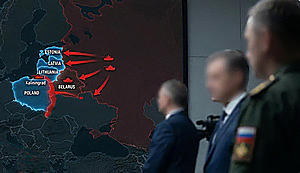
Once Russia is fully convinced of this reality, it may resort to measures considered extreme. For instance, it cannot be ruled out that it might attack one of the Baltic states. And as a condition for ceasing hostilities and liberating the territories it occupies, it will demand that NATO and the EU stop providing aid to Ukraine. However, such actions by Russia are unlikely, as it lacks sufficient forces. Although it is quite capable of demonstrating the threat of an attack. All the more so because such a demonstration would indeed weaken NATO’s and the EU’s focus on Ukraine and would also exacerbate divisions among their members.
Russia may also resort to nuclear blackmail. It would do so solely to issue some kind of ultimatum to Ukraine demanding its surrender and forcing it to accept the terms of a “Russian peace”. It is unlikely to actually use nuclear weapons, but measures must be put in place to deter Russia from doing so. One theoretical option is Ukraine’s participation in the nuclear component of the new European security architecture. This component is currently being discussed at the initiative and under the auspices of France. It could take the form of a European system of forward nuclear deterrence. This system would involve joint action by France and its partners regarding the use of nuclear weapons in case of a nuclear war. France possesses nuclear weapons and delivery systems capable of carrying out nuclear strikes. Its partners are expected to support such actions. The United Kingdom (also a nuclear-armed nation), Germany, Norway, Sweden, Poland, the Netherlands, Belgium, Denmark, and Greece have already joined France’s initiative. It is still too early to predict whether France will agree to nuclear cooperation with Ukraine as well. But even raising this issue would force Russia to be more cautious in its actions.
Thus, Russia’s war against Ukraine is approaching a decisive stage. Over the next two to three months, it will become clear whether the war will come to a halt by mid-autumn of this year or continue into 2027. Several factors will play a key role in this regard: the spread of the economic crisis in Russia, which could become catastrophic as early as the beginning of this autumn and sharply reduce Russia’s ability to continue the war; and the joint efforts of Ukraine, the USA and Europe to force Russia to make peace, which are timed for the same period.
However, Russia will try to do its best to achieve its objectives regarding Ukraine. Therefore, it will intensify offensive operations on the front lines and missile and drone strikes on Ukrainian territory as long as it has the opportunity to do so. At the same time, it will intensify “hybrid wars” against Europe and demonstrations of threats to attack it.
Besides, Russia may issue a nuclear ultimatum to Ukraine, demanding that it surrender and accept Russia’s peace terms. In such a scenario, Ukraine must have the means to deter Russia’s nuclear capabilities.
Yurii Ilchenko,
Institute for Global Politics