Based on remarks delivered at the Institute for Global Politics roundtable discussion, “Challenges in Cross-Border Cooperation and Ways to Address Them”
“Economic policies of states and small economies of cross-border regions are closely intertwined”
Over the years since Ukraine became an independent state within the system of international relations and international economic relations, our region – including its government bodies, executive authorities, local self-government, public and private sectors, social and humanitarian spheres, territorial communities, and non-governmental and civic organizations – has developed a whole range of issues related to cross-border cooperation. This represents a wealth of experience, achievements, and successes, as well as unresolved issues, problems, and corresponding shortcomings. The distinguished guests here have just spoken about this.
By the way, Ukrainian legislation addresses the topic of cross-border cooperation in considerable detail. There is a corresponding legal framework, which was continuously refined in the pre-war period. There is no shortage of institutional imperatives, approaches, or methods for incorporating this into our programs. But, unfortunately, the tragedy we are experiencing – this calamity, this aggression against Ukraine and the entire free world that has come from the East – is a separate issue. And this can be discussed at many other conferences, particularly regarding the Russian-Ukrainian war, Russia’s war against Ukraine and against democracy. The war has exacerbated some problems, pushed others to the background, and led us to believe that certain issues can wait. But some problems in cross-border cooperation simply cannot wait.
What am I trying to say?
We can all see how the tools and mechanisms of cross-border cooperation – which were functioning effectively as of February 24, 2022 – helped us; how they demonstrated cross-border unity; how they showcased the professional cooperation among representatives of local communities, regions, and international institutions involved in cross-border cooperation; and how much humanitarian aid, food, clothing, shoes, technological know-how, knowledge, and positive human energy we were able to bring in, and how we were able to help establish routes of solidarity.
Millions of Ukrainians were driven from their homes by the aggressor, forced to flee on a journey – a massive war-induced migration. Some have become internally displaced persons within their own country, while 4 to 6 million are under the protection of the EU directive. Today, 4.7 million are officially registered, so to speak. Overall, we’re talking about millions of people. And here, cross-border cooperation has shown that this is, after all, not proportional. This isn’t some kind of ritualistic, mystical ceremony where, after the opening remarks, we quickly move on to socializing and the cheerful parts. Here, it has become clear that cross-border cooperation, as a tool and a mechanism, is worthy of attention, since it can produce concrete results in case of an unusual situation.
I’ve read the announcement for our event, and I think the priorities are correctly set. We can use this announcement as a blueprint – whether for our address or our final communiqué. The priorities are correctly set there.
As the head of the Department of International Economic Relations at the Faculty of International Economic Relations of Uzhhorod National University, and as the Director of the Institute of Regional Development, I would like to focus specifically on the issues of cross-border economic ties and the cross-border economy. We held a major conference with our Polish colleagues in Rzeszów, where a wonderful European Union project on cross-border statistics was implemented. Our Polish friends from these cross-border provinces have extensive experience in statistics and in assessing the cross-border economy. And I want to say that we see two sides to this issue. On the one hand, does this cross-border economy actually exist? In the classical sense, it does not. In the process of liberalizing statistics, it is generally very difficult to account for. But it does exist, and it is a cornerstone of the economic policy of the supporting states – the member states of the European Union and Ukraine – which support the entire system of cross-border cooperation.
I’d like to tell you that even under these wartime circumstances, we see that the construction of a narrow-gauge European railway line on the Slovak-Ukrainian border is creating the conditions for the development of a cross-border transport cluster. 100%! I would like to say that the issue raised by Mayor Zoltán Babiak is regrettable. The Lisbon–Trieste–Kyiv highway was supposed to be inaugurated in 2016. The southern route of the motorway has been marked out. Well, that’s how it turned out – due to a whole range of reasons, not just military ones. It’s clear that the Dream system remains in place. Without Dream, we can’t move forward. But look at how we, together with our Romanian partners, resolved the issue of building one of the bridge crossings. How does it open up the meridional route for transport connections? What will be the implications for the formation of a cross-border transportation cluster? This also aligns with the Gdańsk–Thessaloniki meridian highway, which runs not along the route but, so to speak, across it. And, of course, the Via Regia – the oldest and longest transportation link between Eastern and Western Europe. All of this has a massive impact on our region – the Carpathian Basin, the Carpathian transport region.
Next: international industrial parks. This is a topic we know well. There was even a very good idea, because there is the Fenešlitke Industrial Park on Hungarian territory. And the old days, which we are already forgetting, are linked to the oligarchic structure of the Ukrainian economy and to one of the leading figures of that oligarchic economy. The Poltava Mining and Processing Plant was developing a project to establish navigation on the Dnipro River, transport low-grade ores, and deliver them via the Tisa River to the Fenešlitke Industrial Park, and to build an electrometallurgical complex there with a capacity of 3.5 million metric tons… There is no doubt that, if mechanisms for local border traffic were in place, residents of the economically depressed cross-border regions of Hungary, Slovakia, and Ukraine – the tri-border area around Chop, Čierna nad Tisou, and Zahoni – would have excellent job opportunities there. This industrial park already exists. It covers an area of 180 hectares, and there is even a Chinese investor who came with the restoration of the Belgrade–Budapest railway.
You see, national economic policy and the local economies of cross-border regions are very closely linked. On top of that, there are also everyday cross-border arrangements that have been in place for millennia. Millennia! Take, for example, the border crossing in Selmenka, which divides the village on the Slovak-Ukrainian border, or the entire Tysa region, with its international and local border crossing points – the enormous role that the work of establishing and deploying these facilities played when Russian military aggression against Ukraine and democratic countries began. They have played – and continue to play – a colossal role!
In closing, I would like to point out that in this area of cross-border economics, “asymmetries in the economic development of cross-border regions” are very clearly evident (I say this from the point of view of academic findings). This is a serious topic. Polish scholars of cross-border economics have written a large number of monographs, collections, and other works on this subject. And this topic remains relevant.
Of course, with Ukraine’s accession to the European Union – which has not taken place yet – these asymmetries will undergo changes. But even today, the cross-border economy and specific cross-border economic relations are working to ensure that we – even though we are not EU members yet but only a candidate country – can follow Central European paths toward sustainable development and improved quality of life. No matter how difficult things are for the Ukrainian people during the war right now!
And in conclusion, I would like to say that work is ongoing in the field of cross-border initiatives such as cross-border clusters – in forestry, water basin management, educational cooperation, and so on. We had an excellent Visegrad project: the development of a concept for innovative universities in cross-border regions as leaders of local innovative development. And these traditions – they haven’t disappeared; they’re still alive and working. Right now, we’re working very actively with the Maria Curie-Skłodowska University in Lublin to develop dual education programs – training, education, and postgraduate master’s programs, as well as professional development for project managers involved in the investment development of cross-border communities in the Carpathian Euroregion. Such a program exists, and we plan to launch it this autumn. Well, I won’t go into detail here about the social cluster, the spiritual cluster, or the cultural cluster. That’s where it all began, and it has by no means been forgotten. Bishop Bed’ spoke about this today. It is a vast field that must continue and develop.
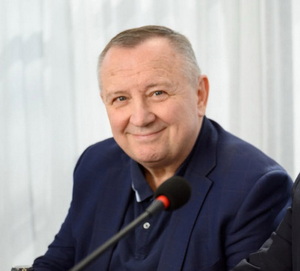
Volodymyr PRYKHODKO,
Head of the Department of International Economic Relations,
Director of the Institute of Public Administration
and Regional Development at Uzhhorod National University,
Doctor of Economics, Professor