“The IAEA Now Resembles More of a Messenger Passing Information from One Warring Party to Another. And Nothing More”
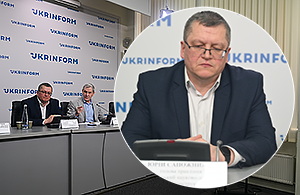
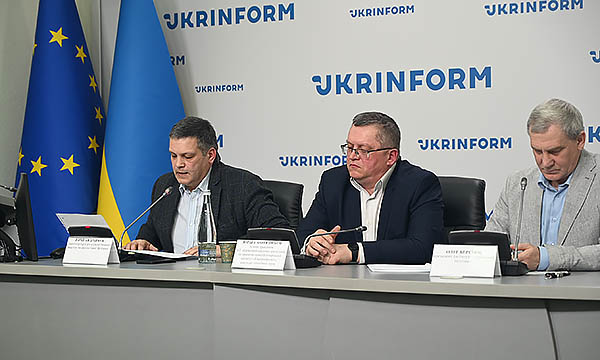
Excerpts from the speech by Yurii Sapozhnikov – Chairman of the Board of JSC “Kyiv Scientific Research and Design Institute ‘EnergoProekt’”, Candidate of Technical Sciences – at a press conference held by the Institute of Global Policy themed “Issues of Nuclear and Environmental Safety in the Conditions of War (as exemplified by the Zaporizhzhia Nuclear Power Plant, the Kakhovka Hydroelectric Power Plant, and International Oil and Gas Pipelines)”
I am a representative of the Kyiv Institute “EnergoProekt”, which is celebrating its 95th anniversary. Over the course of its, so to speak, life cycle, the Institute has designed approximately 80 gigawatts of various power generation facilities. In particular, all of our thermal power plants – Kyiv, Trypillya, Ladyzhyn, and many others. Since the 1970s, we have been actively involved in designing nuclear power plants. We are the general designer, in particular, of the Khmelnytskyi and, in part, the Rivne nuclear power plants. We also carry out many projects related to the Chornobyl nuclear power plant.
I myself have been working at this Institute for about 25 years, with the exception of one year spent at the Ministry of Energy. So, what we are discussing now is something I deal with on a daily basis. And for the first ten of those twenty-five years, I focused on the analysis of nuclear safety.
Safety analysis is a branch of engineering that identifies exactly what could be damaged at a nuclear power plant. For example, what could lead to a core meltdown or to accidents such as those that occurred in 1979 at Three Mile Island in the USA, in 1986 at the fourth reactor unit in Chornobyl, and in 2011 at the Fukushima nuclear power plant in Japan. By the way, not just one core was damaged there, but about five cores, including the spent fuel storage pool.
The consequences of such global accidents are catastrophic. If you look at the dynamics of such developments, they, as a rule, have a very negative impact on the development of nuclear energy as a whole. For example, the Chornobyl disaster led to a significant delay in the development of nuclear energy in Ukraine. Now, if we’re talking about the Zaporizhzhia plant, Unit 5 was launched in 1989, and Unit 6, which was supposed to be launched in 1990, was only launched in 1996 thanks to the efforts of the staff and management of the Zaporizhzhia plant. In other words, such an accident slows down the development of this important industry by at least 10 years. That is why it is extremely important that such accidents do not occur. And we must do our best to prevent such incidents.
What happened in 2022, at the start of the war, was a disaster for me personally. I didn’t even know how to process it. Military vehicles were brought right up to the nuclear facility and fired directly at the power units! You have to understand, no one could ever have imagined such actions against nuclear power plant units! As for the maximum damage they were designed to withstand (VVER-1000 power units, which are all six units at the Zaporizhzhia NPP), that was an accidental crash of a light aircraft. No other external impact was expected…
What could the consequences have been in such a case, if military equipment had appeared there and begun to operate? At those three facilities I mentioned. The answer is unequivocal: the entire territory of Ukraine could have been affected, and, I believe, the entire Black Sea basin! To be honest, under such circumstances, I’m not particularly concerned about the territory of the aggressor country, but the consequences there would have been catastrophic as well. So, the first thing I did when immediate preventive measures were needed was to reach out to colleagues who had the relevant models of these power units, asking them to calculate the probability of damage to the core zones at these power units. Of course, given what we knew was happening at the power units.
Generally speaking, the probability of damage to the core is a figure calculated as one in a million years. In other words, the risk exists, but such an event occurs extremely seldom. As for the situation that arose at the Zaporizhzhia plant at that time, after the calculations were done, I was told (and I wasn’t surprised) that this probability had risen to nearly one. In other words, this is something that could happen right now. I am convinced that we owe a debt of gratitude to the plant’s staff for the fact that it did not happen. But, of course, the aggressor country must bear responsibility for the fact that the plant was exposed to such a risk.
And here we return to the IAEA. This is the body that should be monitoring what is happening, ensuring compliance with nuclear and radiation safety standards and regulations. In Ukraine, this is the responsibility of the State Nuclear Regulatory Inspectorate. It has lost the ability to exercise this oversight due to objective factors. Of course, the absolutely logical step would have been to turn to the IAEA as an international mediator. I can say that the Russians have a fairly significant influence at the IAEA. Unfortunately. I can attest that Russia’s influence and Ukraine’s influence are incomparable. In fact, in this situation, the IAEA now resembles more of a messenger, passing information from one warring party to the other.
A question: Could other functions be introduced for the IAEA? I believe so. I also believe that in light of the tragedy that occurred in 2022, we could speak out and demand the introduction of a different, broader set of functions. But this broader set of functions is effective only if the participants in the process are competent. Unfortunately, after what happened, for example, at the plant itself, and after what happened at the Kakhovka Dam, we cannot assume that we are dealing with a cognizant adversary. Therefore, I believe that all we must strive for is for the Zaporizhzhia NPP to remain Ukraine’s property. We have everything we need – physically, practically, and legally – to ensure this plant does not operate for the benefit of the aggressor country.
Of course, it cannot operate without the Kakhovka Dam, but, in my opinion, any ceasefire will lead to all such negative developments being implemented, and it will be very difficult for us to prevent this.
Regarding the Chornobyl NPP, where the now-famous events also took place. Mr. Tarakanov will tell us more about them. Threats arose there as well, which could also have led to the destruction of the spent nuclear fuel storage facility. This might not have been as catastrophic an accident as the one that occurred at the fourth power unit. But its consequences, as I have already mentioned, would have been a release of radiation over a large area. They would have been catastrophic for the country and for society as a whole.
Yurii Sapozhnikov