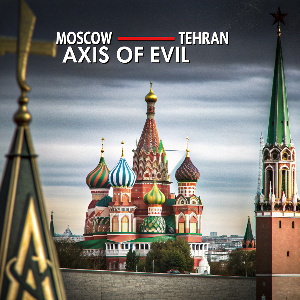
Moscow and Tehran as the Basis of the “Axis of Evil”.
Russia and Iran’s Cooperation Against the United States and Ukraine
The growing US pressure on Russia to end its war against Ukraine is forcing Moscow to unite its partners around it. However, this unification process is somewhat complicated by the secondary sanctions promised by the United States and Europe against such “allies”.
Russia mainly pins its hopes on Iran, which is already under sanctions. It has no other reliable partners besides Russia. Therefore, it agrees to continue close cooperation with Russia. It does not even consider the fact that Russia refused to help after it was attacked by Israel and the United States.
One of the main areas of such cooperation between Moscow and Tehran is their interaction in the military and military-technical spheres, aimed against the United States and Ukraine, as well as Azerbaijan in the Caspian region and the Caucasus.
Deepening such cooperation increases Moscow’s potential in the war against Ukraine and allows it to take a stronger position in negotiations.
US President D. Trump’s categorical demands that Russia stop the war against Ukraine put the aggressor in a rather difficult position, as the Russian economy may collapse, followed by defeat in the war. According to many experts, this is likely to result in a deep socio-political crisis in Russia, which could lead to the fall of the Putin regime and even the collapse of the state. In such a situation, it is of particular importance for the Kremlin to maintain ties with allies and partners as a support for its aggressive course. The urgency of this issue was recognized by Russian Minister of Foreign Affairs Lavrov after D. Trump reduced the so-called timeframe for Russia’s ultimatum from 50 to 10-12 days. And this is true, since the only thing the Kremlin hopes for is an “axis of evil” consisting of Russia itself, Iran and North Korea with the actual support of China.
However, the “axis” is not some kind of hardened monolith, as it may seem at first glance. D. Trump’s threats to impose secondary sanctions on those countries that support Russia may weaken the axis, or at least significantly reduce its effectiveness. First of all, this means China’s possible distancing from the axis. It also faces a choice: to help Russia or not? Because if it does, there will be a risk to simultaneously lose the USA and Europe as its main trade partners.
Most likely, Beijing will not dare to directly confront the West over Russia, and will refuse to massively supply Russia with dual-use products. Of course, it can continue to do so under the guise of North Korea. But such actions are not so easy to hide. That is why the threat of secondary sanctions against China is real, remaining a tangible deterrent. Therefore, China may still reduce its assistance to Russia, and it will hold back the DPRK, which is considered its direct satellite, from doing so.
Thus, of the entire “axis of evil”, only the Islamic Republic of Iran (IRI), which is already under sanctions and has no other patrons but Russia, can remain Russia’s partner Fortunately for Russia, Iran did not abandon it, despite the fact that it was not supported by the RF at the time when it was attacked by Israel and the United States in June of this year. The leaders of both countries confirmed further development of their strategic relations, which is justified by the need to join forces to realize common interests. The main one is openly called countering the West at the global level, as well as in the Middle East, the Caspian region, and the Caucasus. It is in this vein, so to speak, that Iran is supporting Russia in the Russian-Ukrainian war. For its part, Moscow provides Iran with the military technologies it needs and, most likely, assists it in the development of nuclear and missile weapons. Russia is likely to refrain from transferring nuclear warheads, but this possibility is already a threat to the West.
In a word, Moscow and Tehran do not mind active military cooperation. This is confirmed by their joint actions against the opponents of B. Assad’s regime in Syria, as well as actions to support Islamist attacks on Israel and US military bases in Iraq. And with the beginning of the Russian-Ukrainian war, Iran began to supply Russia with unmanned aerial vehicles, shells, explosives, and other military products. Joint military exercises are also taking place. In May of this year, such actions of the parties were enshrined in a separate agreement.
Russia and Iran are interested in developing bilateral trade and economic cooperation. Russia’s main exports to Iran are food products, machinery, equipment, vehicles, wood, and chemicals. Iran’s exports to Russia include fruits, vegetables, dairy products, and seafood. As of the beginning of 2025, the turnover between Russia and Iran reached $ 1.9 billion.
At the same time, the parties are implementing a number of joint projects in the oil and gas industry and nuclear energy. In particular, Russia supplies natural gas to Iran and intends to increase its exports to 55 billion cubic meters a year, which is approximately equal to the capacity of the “Nord Stream–1” gas pipeline. Besides, Russian companies are involved in the development of seven Iranian oil fields. The total cost of the contract is USD 4 billion. It is also planned that Russia will participate in the construction of a new Iranian nuclear power plant.
Another key aspect of cooperation between Moscow and Tehran is their joint participation in the development of the “North-South” transport corridor, which provides a short and efficient trade route between Russia and India through Azerbaijan and Iran. As part of such plans, with the RF’s financial support, the Astara (Azerbaijan)-Qazvin (Iran) railway is being built. Along with this, sea communication through the Caspian Sea is expanding.
A powerful, so to speak, incentive in strengthening ties between Russia and Iran is the sanctions imposed on them by the United States and the EU. In such a situation, Russia and Iran are increasing the volume of mutual trade and switching to settlements in national currencies, which makes it possible to reduce dependence on Western goods and financial systems. For the same purpose, own payment infrastructure is created.
Under such circumstances, Iranian media publications are quite indicative, where Russia’s refusal to assist Iran in repulsing the strike by Israel and the United States. In fact, repeated are the arguments of Russian propaganda about the absence of relevant provisions in the contract on comprehensive strategic partnership between Russia and Iran, which they signed in January 2025. Besides, Russia itself is short of air defense equipment which it could have transfered to Iran. This neutralizes the negative impression of Iranian society from actions of Russia, which actually left Iran to fend for itself in the above-mentioned situation. At the same time, there is an opinion about the need to continue cooperation between Russia and Iran in all of these areas. At the same time, there is an opinion about the need to continue cooperation between Russia and Iran in all of these areas. In particular, in this key was commented on the joint naval exercise of the two countries CASAREX-2025 (Combined Aid and Rescue Exercise 2025), held on July 21-23 this year in the Caspian Sea. The exercise has already been discussed in the Ukrainian media, but it requires special attention, as it clearly indicates the preservation of close Russian-Iranian ties in the military and military-technical spheres. Moreover, its coverage in the media was incomplete, that is, without an in-depth systemic analysis. So let’s analyze everything in more detail.
Thus, the CASAREX-2025 exercise involved the forces and means of the Caspian Flotilla of the Russian Navy, the Northern Fleet of the Iranian Armed Forces, the Iranian Islamic Revolutionary Guard Corps Navy (IRGC is something like the KGB troops of the former USSR) and the Iranian Maritime Police. Besides, the exercise was attended by observers from the Caspian Sea countries and a number of other states, including China. According to official reports from the military agencies of Russia and Iran, the exercise was search-and-rescue oriented and was conducted to improve maritime security and strengthen cooperation between the navies of the Caspian Sea countries. The exercise was organized by the Iranian Navy, and its slogan was “Together for a Safe and Secure Caspian Sea”.
On the surface, the exercise did indeed correspond to the stated goals. In particular, search and rescue operations were carried out for a distressed vessel, and issues of navigation safety were improved, including the conduct of convoys, countering possible attacks on ships, and the detection and liquidation of mines in sea lanes.
However, some of the measures taken during the exercise went beyond the scope of such operations. In addition to the aforementioned tasks, the following issues were also addressed: strikes on maritime and coastal targets in the form of live artillery fire and simulated missile launches; combat use of UAVs; air defense; actions of naval special forces to capture ships; and radio jamming. Besides, the Iranian media mentioned “offensive operations” in the context of the exercise.
The composition of the participants in the exercise was quite unusual. Russia provided the rescue vessel (tug) SB 738 Rosb and a marine special forces unit (there may have been other ships and vessels, but they are not mentioned in available sources). Iran also provided two tugs, the “Kharaz” and the “Enzeli”, as well as the maritime police vessel “Heydar” and the port administration vessel “Pak Boom”, which can be considered relevant to rescue operations. At the same time, the missile frigate “Separ”, the corvette “Darsharsh”, and the missile boats “Peikan” and “Joshan” from the Iranian Navy were involved, which are purely combat and, even more so, strike vessels.
Furthermore, as already mentioned in the article “Once Again About the Second Front for Russia. War in the Caucasus Is Becoming a Reality”, CASAREX-2025 coincided with the Russian Navy’s “July Storm” exercise, during which large-scale naval operations were simulated. The Russian Navy’s Caspian Flotilla was involved in the exercise, including its missile ship “Dagestan” and small missile ships “Tucha”, “Amur”, and “Uglich”, as well as a division of the “Bal” coastal missile system. In other words, the same composition of combat ships that participated in the CASAREX-2025 exercise from the Iranian Navy.
According to Western experts, all this indicates the broader nature of the CASAREX-2025 exercise, which had both purely stated and military-political objectives. The main ones were:
- confirming the unity of Russia and Iran and the strategic partnership between them, despite certain complicated issues in their relations;
- demonstrating strength in the region and readiness to use it to achieve their goals;
- strengthening the positions of the Russian Federation and the Islamic Republic of Iran in the Caspian region and increasing control over it by demonstrating the ability to conduct joint military operations within its borders;
- deepening military cooperation between Russia and Iran and consolidating their naval presence in the Caspian Sea;
- working out issues related to the protection of the North-South transport corridor;
- preventing a revision of the current principles of division of the Caspian Sea, which are most in line with the interests of Russia and Iran.
A separate aim of the exercise could also have been to warn Azerbaijan against speaking out against Russia and Iran, as well as against supporting Israel and the USA.
The exercises took place against the background of the current deterioration in relations between Russia and Azerbaijan, which is taking the form of confrontation between the parties with elements of a demonstration of military force. This was discussed in more detail in one of the previous articles mentioned above. To this can be added the fact that Azerbaijan and Turkey are considering plans to establish a Turkish military base on Azerbaijani territory, which is an open challenge to Russia. And after Israel and USA’s attack on Iran, its relations with Azerbaijan deteriorated. In particular, Tehran accused Baku of providing its air bases to Iran’s adversaries.
According to analysts, Russia and Iran’s joint actions are indeed complicating Azerbaijan’s position, forcing it to maneuver between economic dependence on them and the desire to deepen relations with Turkey and the USA. However, Azerbaijan is joining forces with Kazakhstan, which also has contradictions with Russia and Iran, to counter them. Joint naval exercises are planned.
As for the military and political objectives of the aforementioned exercises, they were confirmed by Russian Navy Commander Admiral O. Moiseev, who was present there. According to him, Russian ships arrived near the Iranian coast to strengthen the naval power of Iran and Russia.
Thus, despite the problems that have arisen in Russia’s relations with Iran, these countries continue to actively cooperate in political, economic, and military spheres. The reason is obvious: the parties’ common interests outweigh everything else. This preserves the “axis of evil”, which includes Russia, Iran, and North Korea. As a result, with China’s support, this axis will continue to be able to oppose the West, posing a threat to the democratic world. Incidentally, this will contribute to strengthening of other totalitarian regimes.
In the current situation, Russia has the opportunity to rely on the help of Iran and North Korea in its war against Ukraine. This allows it to take a tougher stance in negotiations with the USA and Ukraine.
At the same time, the activities of Russia and Iran in the Caspian region are leading to increased tensions between them and Azerbaijan and Kazakhstan. If tensions in the region continue, various clashes may happen, with the use of weapons included, which increases the likelihood of a second front for the Russian Federation.
Yurii Ilchenko,
Institute of Global Politics
(Image generated by neural network)