SUMMARY OF THE DEVELOPMENT OF THE MILITARY-POLITICAL SITUATION IN THE WORLD IN 2025 IN THE CONTEXT OF UKRAINE’S NATIONAL INTERESTS
Part 6
Part VI. Measures Taken by Russia and the USA/ NATO for Mutual Military Deterrence and Preparation for a Possible War Between Them
As part of their military preparations, Russia and the USA/NATO conducted military exercises in the European theater of operations, during which various scenarios of armed conflicts and full-scale war between them were worked out. The possibility of using tactical and strategic nuclear weapons was also considered. Such measures by the Russian Armed Forces and the US Armed Forces and NATO forces were generally symmetrical in nature, but differed in intensity and scale.
Thus, due to the most of Russia’s armed forces’ involvent in the war against Ukraine, large-scale exercises such as SKSHN “West”, “Caucasus”, “Center” and “East” were suspended in 2022. The exception to this was the exercises of the Northern, Pacific, and Baltic Fleets without the involvement of their marine components. In particular, exercises such as “Ocean” and other operational and combat training activities continued. However, these were also smaller than before the war, as Russia lacked funds. Besides, nuclear submarines with ballistic missiles on board were deployed to designated combat duty and patrol areas.
In 2024, Russia attempted to resume joint strategic exercise with Belarus, such as “West”, which was intended to pressure Europe on the issue of its support for Ukraine by demonstrating military force. However, it was unable to do so due to a lack of resources.
In 2025, Russia and Belarus did conduct the “West-2025” with the same goal as planned. However, it were significantly smaller in scale than before the full-scale war, and the Belarusian Armed Forces became its main participant. Despite this, the exercise caused a significant stir in Europe and Ukraine. Concerns were expressed that Moscow could use it as a cover for preparations to attack Europe and re-invade Ukraine from the north.
In reality, this did not happen, although the Russian media presented the exercise as evidence of Russia’s readiness and capability of defending its interests by military means. And in order to create the impression of the exercise’s power, CSTO’s exercise was held on the eve of its start.
Until 2022, after the completion of the above-mentioned exercise, strategic command and staff exercises of the Russian Armed Forces’ Strategic Missile Forces were usually conducted with the involvement of their ground, air, and naval components. During such exercises, practical launches of ballistic and cruise missiles were carried out. Such exercises are still held today, but on a smaller scale.
Unlike Russia, the USA and NATO have increased the scale of their military exercises in the European theater of operations. Alliance member states have also stepped up their national-level exercises and joint training and combat activities with their partners. Since 2014, the main ones have been joint exercises such as “Defender”, which combine a set of interrelated exercises of individual components of the US Armed Forces and NATO forces. Other exercises are also conducted with them on a single operational background.
In 2025, the main operational and combat training event for the US Armed Forces and NATO forces was the “Defender Europe-25” joint exercise (also known simply as “Defender-25”), which took place in April-June across the entire European theater of operations. The US Armed Forces were the main participant in this event. Units from most other NATO member countries acted jointly with them.
Besides, annual exercises are conducted involving the tactical and strategic nuclear forces of the US and NATO (France and the UK, which have their own nuclear weapons, and NATO member countries that have means of delivery). The main ones are the tactical exercises “Steadfast Noon” and the strategic exercises “Global Thunder”.
In line with the USA’s plans to reorient some of its forces from Europe to the Asia-Pacific region, the second half of 2025 saw the beginning of a gradual reduction in the USA’s participation in exercises in the European theater of operations. However, this reduction has been insignificant so far.
6.1. Russia
Prior to the start of Russia’s full-scale war against Ukraine in February 2022, joint military exercises such as the “West” were a key element of the operational and combat training (OCT) of the Regional Grouping (RG) of Russian and Belarusian troops. The main tasks of the RG were and remain the deterrence of NATO on the western and northwestern directions, and in case of war, the conduct of front-line defensive and offensive operations. These were the issues addressed at the aforementioned joint military exercises. At the same time, the Russian leadership used them as a means of pressure on Europe and the USA by demonstrating its strength.
Since then, the Russian Armed Forces’ OCT system, as the main component of the RG, has been completely changed and is now mainly focused on preparing Russian troops and units to participate in combat operations on the front lines in Ukraine. The Russian Armed Forces do not carry out classic divisional, army, or, even more so, front-line operations there. Therefore, there is no need for exercises on such topics in the context of Russia’s war against Ukraine. They are necessary for Russia to deter NATO and prepare for a possible war with it, but it lacks the resources to do so. With this in mind, the “West-2025” exercises were significantly smaller in scale than previous ones, although they pursued the same political and propaganda goals.
Thus, the main part of the “West- 2025” exercise was held in September 2025 on the territory of Belarus, and individual events were organized at training grounds in the Moscow and Leningrad Military Districts of Russia. This was quite logical, since the western regions of the RF are within the range of Ukrainian missiles and UAVs, and therefore their participants could be hit.
On the eve of the exercises, it was officially announced that about 30,000 soldiers and officers would be involved. Of those, 8,000 were operating in Belarus, including 6,000 Belarusian and 2,000 Russian military personnel. During the exercises, Putin began to claim that more than 100,000 people were participating in the exercise, with the aim of creating the impression of its greater power. This was used by Russian propaganda to prove that Russia had sufficient forces not only to continue the war against Ukraine, but also to exert military pressure on Europe.
However, such statements by the Russian president were clearly exaggerated or were based on the total number of troops in the Moscow Military District, where the exercise took place. This number also includes conscripts who are not sent to the front.
According to statements by the leadership of Russia and Belarus, the “West-2025” exercise was not directed against any specific countries or their alliances, and its scenario was hypothetical. At the same time, representatives of Belarus emphasized that the exercise did not pose a threat to Ukraine.
However, the objectives of the exercise were openly stated as follows: deepening military integration between the Russian Federation and Belarus; demonstrating the strength of the Union State; deterring the USA and NATO; and improving the Russian-Belarusian military security system. The latter issue was given a special role in the context of the implementation of the bilateral security guarantee agreement of December 6, 2024.
The document is based on the national security concepts and military doctrines of the two countries, including their nuclear component. It focuses on the allegedly aggressive actions of the USA and NATO towards Russia and Belarus, which include: intensification of anti-Russian and anti-Belarusian military exercises; provocations near the Russian and Belarusian borders; the build-up of troop formations and the development of military infrastructure in neighboring countries; the intensification of intelligence activities against the RF and Belarus; calls for military action and support for it in Ukraine. Within the framework of this approach, Ukraine is named as a source of threats to Russia and Belarus.
The “West-2025” strategic exercise was combined with the CSTO’s exercises “Interaction-2025”, “Search-2025”, and “Echelon-2025”, which were held on Belarusian territory. Through this, Moscow attempted to demonstrate the unity of Russia and its allies from among the countries of the former USSR in opposition to the USA and NATO, which in reality does not exist. In view of the above, the exercise was also Moscow’s military-political tool to strengthen its position in the post-Soviet space.
In line with the aforementioned objectives, the scenario of the “West-2025”, like previous exercises of this type, involved working out one of the options for the use of the Regional Grouping of Forces of Russia and Belarus in a war with the USA and NATO in the European theater of operations. Given the involvement of most of the Russian armed forces in the war against Ukraine and the dominant superiority of NATO forces over the Belarusian armed forces, the exercise most likely focused on the tasks of conducting a strategic defensive operation. However, they could also have included an offensive component.
One of the central episodes of the exercise was the training of the “Oreshnik” missile system, which was allegedly transferred by Russia to the Belarusian armed forces. In addition, there were exercises of the Belarusian armed forces units that can use Russian tactical nuclear weapons located on Belarusian territory. However, experts continue to express doubts about the fact that Russia transferred the “Oreshnik” complex to Belarus, at least in full configuration and combat-ready form. And the strike with such a missile on Ukraine on January 9, 2026, demonstrated its low effectiveness in non-nuclear equipment.
During the preparation for the strategic exercise, a whole range of standard measures were taken, including: partial conscription of reservists into the Belarusian armed forces; retrofitting of training grounds and field camps; repair and modernization of transport communications; relocation of certain units of the Russian armed forces to Belarusian territory; and training exercises to prepare for future actions during the exercise.
At the same time, the “West-2025” exercise differed from previous exercises of the kind. As noted above, it involved significantly fewer personnel than before. In addition, it was conducted deep inside Belarusian territory, rather than near the RB’s borders with Poland, Lithuania, and Ukraine. According to the Belarusian leadership, this was intended to reassure Europe and Ukraine and demonstrate that the exercise did not pose a threat to them. Unlike in 2013 and 2021-2022, no strike forces were deployed on the border with Ukraine. There were also none in the directions of Poland, the Baltic states, and Northern Europe. The active phase of the exercises lasted only five days, whereas previously it took at least two to three weeks.
In other words, despite attempts to intimidate Europeans, Russia and Belarus demonstrated that they did not have the strength to attack Europe and were unwilling to exacerbate relations with it due to the threat of tougher sanctions.
On October 22, 2025, two intercontinental ballistic missiles were launched from land and sea bases, including from the Plesetsk cosmodrome – the “Yars” ICBM to the “Kura” test site in Kamchatka and from the Bryansk nuclear submarine – the “Sineva” ICBM.
6.2. The USA and NATO
The “Defender Europe-25” joint military exercise was standard for this series of exercises. The main goal of the event was to demonstrate and test the the USA and NATO’s readiness to defend Europe from aggression from the east. Russia was not officially designated as an enemy, but in fact was defined as such in the exercise scenario, which involved working through all aspects of a full-scale war with Russia.
Thus, during the exercise, the following tasks were addressed: deployment of NATO’s Rapid Response Forces in threatening areas; transfer of American troops from the continental United States to Europe; creation of Alliance forces to repel enemy attacks; organization of defensive and counteroffensive operations.
The exercise took place from April to June 2025 across the entire European theater of operations, from the Arctic and Baltic regions to the Mediterranean and Black Sea regions. Elements of the exercise were conducted in 18 countries, including Albania, Bulgaria, Croatia, the Czech Republic, Finland, Greece, Hungary, Kosovo, Latvia, Lithuania, Montenegro, North Macedonia, Norway, Poland, Romania, Slovakia, Slovenia, and Sweden.
Twenty-five thousand personnel from the Armed Forces of the USA and NATO member countries were involved in the active phase of the exercise. Of these, 5,400 were US military personnel deployed from the continental United States. The exercise was conducted under the leadership of the US Joint Command in Europe and Africa and consisted of three separate exercises, namely:
“Swift Response-25” – focused on the deployment of US troops to Europe and landing of airborne troops in Finland, Norway, Latvia, Lithuania, and Sweden;
“Immediate Response-25” – focused on conducting defensive operations and countering enemy attacks in cyberspace. The main events were organized in Albania, Bulgaria, Croatia, Greece, Kosovo, Montenegro, North Macedonia, and Slovakia;
“Saber Guardian-25” – modeled the actions of allies in carrying out a counteroffensive operation. It was held in Poland, the Czech Republic, Hungary, and Romania.
Other exercises were linked to “Defender Europe 25”, including “Steadfast Dart”, “Dacian Spring”, “Dynamic Front”, “Mavi Vatan”, “Sea Shield”, “Dynamic Mariner/Flotex”, “Dynamic Manta”, “Feldberg”, “Arctic Forge”, “Joint Viking”, “Allied Spirit”, and “Steadfast Noon”.
NATO’s response to the Russian and Belarusian joint military exercise “West–2025” was also noteworthy. In response, a series of exercises were conducted, including: in Poland – “Iron Defender-25”; in Lithuania – “Perkūno Griausmas” (“Thunder of Perun”); in Latvia – “Namejs-25”; in Finland – “Karelian Fortress”, “Southern Griffin-25”, “Kinetic Stronghold-25”. According to NATO representatives, they became a clear signal of allied solidarity within the Alliance and a means of joint deterrence against Russia.
The readiness of the USA and NATO nuclear deterrence system to perform its tasks was tested during the tactical nuclear exercises “Steadfast Noon-25” in October 2025 and the strategic exercise “Global Thunder-25” in November of the same year, which took place against a single operational background with the participation of all components of the US nuclear forces and their NATO allies.
The exercises were intended to confirm and enhance the readiness of the US and NATO nuclear deterrence system for combat use in case of a conventional war escalating into a limited or full-scale nuclear war or a sudden enemy attack.
Thus, during the “Steadfast Noon-25” exercise, issues related to the use of US and some NATO countries’ tactical aviation to deliver nuclear strikes during a limited nuclear war in the European theater of operations were worked out. This involved the conditional use of US tactical nuclear bombs stored in Europe and tactical nuclear munitions from France and the UK.
The “Global Thunder-25” exercise addressed the tasks of US and NATO strategic nuclear forces (SNF) in the context of a full-scale nuclear missile war. All components of the US Armed Forces’ SNF and their support units, including reconnaissance, command, communications, and logistics, were involved in the exercise. In addition, the staffs and units of the French and British nuclear missile forces participated.
In May 2025, the US Armed Forces conducted a test launch of a “Minuteman III” ground-based intercontinental ballistic missile. The missile was launched from the US Space Force’s Vandenberg Air Force Base in California and flew 6,700 km.
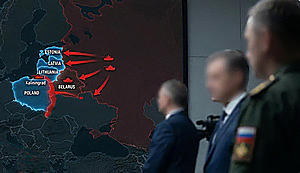
The operational and combat training exercises conducted by the Russian Armed Forces, the US Armed Forces, and NATO forces in the European theater of operations were, in fact, preparation for a possible war between them. The most likely place for it to break out is the Baltic region, where the situation is most tense. At the same time, the scale of the “West–2025” military exercises demonstrates that Russia does not have sufficient forces to attack Europe without ending the war against Ukraine.
Yurii Mykhailenko,
Institute for Global Politics
(Image generated by neural network)