Problems with Ukraine’s Security Guarantees and Possible Ways to Address Them
The main issues for Ukraine are to increase its ability to confront Russia and to obtain firm security guarantees. At the same time, the situation around the Russian UAVs’ incursion into Poland has demonstrated that NATO has problems in providing reliable protection for its members and partners. Therefore, Ukraine needs to look for additional opportunities to strengthen its security, including uniting with other countries in the same situation.
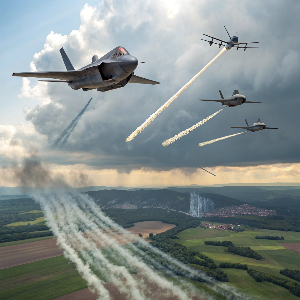
According to Ukraine’s official position, the main guarantee of its security should be full membership in NATO. Therefore, joining the Alliance is defined as its strategic goal. There is an objective basis for this. Despite the complication of internal problems, the Alliance remains the most powerful and effective collective security system in the world. This is evidenced by the situation when about 20 Russian UAVs invaded Poland on the night of September 9-10. It was the first time this had happened. One or two more drones entered Lithuania’s airspace. Until now, only a few UAVs had entered Poland, Lithuania, Latvia, Estonia, and Romania. At the same time, the Alliance’s reaction to this incident raises some doubts about its readiness to guarantee reliable protection of its members.
Thus, the Alliance has fulfilled its obligations on collective defense. The Netherlands’ F-35s, which protect Polish airspace as part of the NSATU mission, were involved in repulsing the attack along with Poland’s F-16s. The planes, which are stationed at the Krzesiny air base near Poznan, began patrolling on September 1.
The main task of the Dutch planes is to help Poland protect the Jasionka air base near Rzeszów, where there is a logistics center that provides weapons to Ukraine. It was one of the targets of the Russian attack. In addition, the center is covered by two batteries of Patriot air defense systems from the Netherlands.
The Patriot air defense systems of the German Armed Forces deployed in Poland were put on high alert. They detected the UAVs with their radar, but did not open fire. Together with the Polish Saab-340 AEW&C long-range radar detection aircraft, the Italian E-550A radar aircraft was performing the task.
At the same time, in accordance with Article 4 of the North Atlantic Treaty, consultations were held on the incident. The NATO leadership condemned Russia’s actions and determined that it was necessary to strengthen the Alliance’s air defense system. In view of this, a decision was made to conduct Operation “Eastern Sentry”, which provides for strengthening the Alliance’s air defense on the Russian direction.
The operation involves the forces and means of Denmark, France, the United Kingdom, Germany and the countries of Central and Eastern Europe, the Baltic States and Northern Europe. These are mainly fighter aircraft and radars, air defense systems, ground-based airspace control radars, as well as bases and airfields. It is planned to redistribute responsibility for airspace defense. Now, forces will be concentrated where they are most needed, and gaps in defense will be eliminated.
US President D. Trump refrained from giving a clear assessment of the incident. At the same time, according to Acting US Permanent Representative to the United Nations D. Shea, America will also join measures to strengthen Europe’s air defense.
A number of NATO member states have come up with their own initiatives to urgently assist Poland in strengthening its air defense. In particular, Sweden is sending air defense equipment and aircraft to Poland, the Netherlands is sending two batteries of Patriot air defense systems, and the Czech Republic is sending three helicopters to counter UAVs. Germany and the United Kingdom have decided to extend the stay of their fighter jets in Poland, which were delivered there on the eve of the West-2025 SCPE of the Armed Forces of Russia and Belarus.
At the same time, the NATO leadership did not take more decisive steps, such as ultimatum demands to Moscow that such attacks should not be repeated. Moreover, doubts were expressed that it was Russia that launched the drones. Therefore, a corresponding investigation was launched. Hungary and Slovakia even suggested that it could have been a provocation by Ukraine.
The above-mentioned measures to strengthen the air defense system of NATO’s eastern borders and Poland itself are rather limited in nature. In fact, it is only a redeploying the existing forces and means to the most threatened areas. This may to some extent increase the effectiveness of the Alliance’s air defense, but it will not completely resolve the problem.
This situation is particularly negative in nature due to the shortcomings in NATO’s air defense system, as demonstrated by the UAV incident in Poland. In particular, despite its power, only three out of 19 drones were shot down. The reason for this outcome is that the system is designed to counter missiles and aircraft and does not meet the latest needs, when the main threat is UAVs.
Besides, NATO has given up the quite logical step of using its air defense assets in the neighboring countries of Central and Eastern Europe to destroy Russian air assets over Ukrainian territory. This would have made it possible to really strengthen NATO’s defense against the threat of air strikes from Russia. However, such a step would actually lead to a military confrontation between the Alliance and the Russians.
In order to avoid such prospects, Brussels is essentially sacrificing the security of Poland, and with it Romania, Hungary, Slovakia, and the Baltic states, which could also be targets of Russian strikes. Moscow understands what is happening and is trying to put pressure on NATO to undermine its unity and spread panic in the European environment. At the same time, it also wants to ensure that the Alliance stops supplying Ukraine with air defense systems. But none of the NATO members has even put on the agenda the need to strengthen sanctions against the Russian Federation.
Most likely, if it happens that Russia actually attacks Poland with missiles and UAVs with real combat units, and even more so with a ground invasion by Russian troops, NATO will invoke Article 5 of the North Atlantic Treaty. However, judging by what is happening in the Alliance, this will also be fraught with difficulties and will take some time. At the same time, the “fifth column” in NATO in the form of Hungary, Slovakia, and various right-wing, left-wing, and other pro-Russian forces will not only not go away, but may even intensify its behavior.
If Ukraine joins NATO, it will certainly face the same problems as Poland. They will even be more complicated because of their different positions.
For example, Ukraine is located between Poland and Russia. Therefore, Poland borders only on Kaliningrad region of Russia and Belarus. There is no Russian strike force in this region, and it is not easy to create one. Russia can deploy its troops to Belarus, but not immediately. And the process of their redeployment cannot be concealed.
Therefore, Russia cannot attack Poland suddenly. As a result, NATO would have time to resolve all issues related to the provision of military assistance to Poland. And this is not to mention the fact that the US 5th Army Corps and the headquarters and units of NATO’s Multinational Rapid Deployment Corps are already on its territory. They would all fight Russian troops in case of an invasion.
As it is now, Ukraine will be in a different environment. It will continue to border Russia. And Russian troops would remain on the Ukrainian border. Their number would not only not decrease, but will grow as our country integrates into NATO. Given this, Russia would retain the ability to attack Ukraine again without much preparation. As a result, the Alliance leadership would be forced to make decisions on the use of Article 5 on collective defense in a very short time, which would be a serious problem for the reasons mentioned above.
And this is at best. In fact, in the short term, neither the United States nor other leading NATO member states will agree to grant Ukraine full membership in the Alliance. None of them will dare to aggravate relations with Russia, which is categorically opposed to Ukraine’s accession to the Alliance. Especially during the war, when Ukraine’s membership in the Alliance would automatically start an armed confrontation with the Russian Federation.
The same applies to the plans to deploy Western troops on the territory of Ukraine. For the same reason mentioned above, they would not be realized before the end of the war. Russia would not agree to them even after the war, as it has clearly stated. As we have written in previous articles, only a military training and civilian mission of the EU and, possibly, small air defense units may appear in Ukraine. Moscow would not agree to anything more.
Of course, we can hope that Russia will be critically exhausted and this will force it to stop fighting and start peace talks. And then it will be put in a hopeless position where it will not be able to oppose NATO and Ukraine. I would like to believe this, but underestimating the enemy is unacceptable in any case.
Based on the above, along with continuing Ukraine’s strategic course toward NATO membership, it is necessary to intensify efforts to find additional ways to increase Ukraine’s capabilities in confronting Russia and thus guarantee its security.
In the second half of the 2000s, when the United States and the CEE and Baltic states supported the idea of Ukraine’s accession to NATO, while Germany, France and a number of other European countries opposed it, the idea of creating a so-called NATO-2 was put forward. It was proposed to include the United States and countries interested in Ukraine’s membership. However, this initiative was never implemented.
Because of D. Trump’s position, it is impossible to create something like this now. It seems more realistic for Ukraine to join forces with other countries that are also under the threat of Russia’s aggression and have similar security problems to ours. First and foremost, these are Poland and Lithuania, which are not far from us, although they are NATO members and share a common border only with Kaliningrad region of Russia and Belarus.
This was demonstrated by the situation around the arrival of Russian UAVs in Poland and Lithuania and NATO’s response to them. As already mentioned, these countries have been the target of Russia’s aggression, but the Alliance has not provided them with full assistance, even though they are members. Similarly, the Alliance promises security guarantees to Ukraine, but limits itself to providing military and technical support.
Ukraine, Poland, and Lithuania share a common past and experience of military cooperation in modern conditions, which can serve as a basis for building some form of alliance between them. For example, in the twelfth and sixteenth centuries, they were part of a single state, the Grand Duchy of Lithuania, and jointly opposed the Golden Horde and then its offspring, Muscovy. Unfortunately, as a result of disagreements between Ukraine, Poland, and Lithuania, the Grand Duchy ceded to Muscovy. And then Moscow took control of its constituent parts, first within the Russian Empire, and then the USSR and the Soviet bloc.
After the collapse of that bloc, Ukraine, Poland, and Lithuania became independent. As is well known, Poland and Lithuania have become members of NATO and the EU and are actively lobbying for Ukraine’s interests in these organizations. And since Russia’s first attack on Ukraine in 2014, they have been strongly on the side of our country and have been among the main initiators of providing assistance to Ukraine and increasing pressure on Russia.
After Moscow launched a full-scale war against Ukraine in 2022, the interaction between the three countries reached a qualitatively new level. This interaction could be the subject of a separate article or even a book. Therefore, I will focus only on the most characteristic facts. In particular, Poland has officially allowed its citizens to participate in the war on the side of Ukraine. And Lithuania does not object to the same actions of its citizens. Most of the weapons are supplied to our country through Poland. Intermediate storage facilities are located in Poland. For its part, Ukraine actually takes care of Poland’s air defense. And this is not to mention the fact that Ukraine separates Poland from Russia and prevents the latter from reaching the Polish border.
All of this can be consolidated and expanded within a certain organization like the Visegrad Four, which includes Poland, the Czech Republic, Slovakia, and Hungary. It was founded in 1991 to facilitate the joint integration of these countries into Euro-Atlantic structures, to cooperate in areas of mutual interest, and to strengthen stability in the region. The organization has played its role, which demonstrates the feasibility of creating such structures.
The experience of the Visegrad Four and similar organizations could be used for the interstate association of Ukraine, Poland, and Lithuania. In the future, other interested countries could join it, which will make it possible to fill the idea of building a Baltic-Black Sea Union with more real content. The union would not eliminate all problems, but it would provide more opportunities for this.
As with other similar plans, a number of problems would arise with the implementation of this initiative. Russia would certainly oppose it. It is unclear how NATO and the EU would react to this, as they could perceive it as undermining their unity and a mechanism for drawing them into a war. Defining the goals and functions of the association, as well as the obligations of its members, would also require considerable effort.
Such difficulties are not fundamental and can be overcome through appropriate consultations and negotiations. And the initial step in implementing the initiative could be to hold international conferences with the participation of all interested parties.
Thus, the situation around the Russian UAVs’ large-scale incursion into Poland demonstrates that NATO has problems in ensuring the security of its members. An even more problematic issue is the Alliance’s ability to guarantee Ukraine’s security. These circumstances call for additional ways to strengthen Ukraine’s capabilities in confronting Russia. One of them may be to join forces with other partners who face similar challenges and feel threatened by Russia.
First of all, these are Poland and Lithuania. Ukraine shares a common historical past with them, and they have experience in countering Russia’s aggression in the current environment. This can serve as a basis for establishing an international Ukrainian-Polish-Lithuanian organization.
The first step in this matter should be to bring it to the attention of the interested parties at a conference. It will allow to determine the degree of interest of potential participants in such an association, as well as the main directions of action for its formation.
Yurii Mykhailenko,
Institute for Global Politics
(Image generated by neural network)