The SCO and Russia: From a Tool of Influence in Asia to China’s “Fiefdom”
One of the consequences of the Russia-Ukraine war is that Russia has lost its geopolitical influence in regions of the world that are important to it, including the post-Soviet space. It is also losing control over international organizations that were created with its leading participation to promote its interests. China has seized the initiative from Russia in the SCO and BRICS and is using them for its own purposes. This is evidenced, for example, by the SCO summit in Bishkek on August 31–September 1, 2026. China used the summit to strengthen its ties with Central Asian countries, which Russia considers its sphere of exclusive influence. Moreover, the summit participants not only failed to support Russia’s war against Ukraine but also used the SCO platform to urge Putin to end it.
The Shanghai Cooperation Organization was established in 2001 at Russia’s initiative, which was supported by China and a number of other countries. The Organization comprises ten countries, including Belarus, India, Iran, Kazakhstan, Kyrgyzstan, China, Pakistan, Russia, Tajikistan, and Uzbekistan. The total land area of the Organization’s member states accounts for 62% of Eurasia’s total area; in terms of population, they represent 41% of the world’s population; and their combined economy accounts for 25% of the global economy.
Officially, the Organization is dedicated to developing cooperation with the aim of strengthening peace, security, and stability in the region; it promotes the establishment of a democratic and just international political and economic order; jointly fights terrorism, separatism, and extremism; deepens regional ties in the political, trade and economic, energy, transportation, defense, and other spheres; and promotes the region’s economic development and its integration into the global economy.
To this end, relevant bodies and the SCO Interbank Association have been established.
The member states of the Organization share common goals. At the same time, within the SCO, each member has its own interests, which in some cases may be conflicting. This applies primarily to Russia and China, as the leading participants in the Shanghai Cooperation Organization.
For example, in the early 2000s, Russia proposed the creation of the SCO in order to strengthen its influence over the countries of Central and Southeast Asia and expand access to their markets. In this way, Russia sought to counterbalance the West and secure additional opportunities for its economic development. In pursuing these plans, Russia relied on its ties with the aforementioned countries of the former Soviet Union.
China also had similar goals regarding the SCO; during the Cold War, it was effectively the leader of the Third World – that is, those countries that belonged to neither the Western nor the Eastern blocs. But even then, starting in Asia, China was laying the groundwork for expanding its influence around the world. In the early stages, Russia effectively dominated the SCO. It had overcome its economic crisis, which enabled it to pursue an active, assertive foreign policy. The Chinese economy was also developing rapidly, but at that time, China was primarily focused on domestic affairs and remained fairly restrained on the international stage.
The plans of other SCO member states were largely pragmatic. Most of these countries had disputes with the United States and Europe and sought to counter pressure from them with the help of Russia and China, including within the framework of the Shanghai Cooperation Organization. In particular, cooperation within the SCO framework allowed them to limit the use of the US dollar and conduct transactions in their national currencies. As a result, Moscow managed to significantly expand its influence over Central Asian countries and strengthen ties with India, Pakistan, and Iran. At the same time, relations between Russia and China were actively developing, with Russia’s dominance or, at the very least, on the basis of equality. Thus, Russia’s position in Asia was strengthening. However, it was never able to fully use the SCO as a real counterweight to the West, since the other member countries of the Organization were not interested in this.
This state of affairs persisted until the first half of the 2010s, when China began to emerge as the world’s second-largest center of power after the United States. Meanwhile, Russia’s economic growth began to slow down, and following its invasion of Ukraine in 2014, it fell under Western sanctions. As a result of the full-scale invasion of Ukraine in 2022, Russia’s situation worsened further. It found itself internationally isolated by the West, and its economy was plunged into a deep crisis.
Russia sought to use the Shanghai Cooperation Organization (SCO) as a bulwark in its confrontation with the United States and Europe. To some extent it did succeed. However, in general, the SCO could not provide Russia with a decisive advantage. Moreover, the RF even began to suffer setbacks in this regard.
Thus, China has decisively seized the initiative from Russia within the SCO, having pushed Russia into the background. It is now China, not Russia, that sets the tone for the Organization’s work. This is clearly linked to China’s dominant economic advantage over Russia, which determines their respective roles and positions in the world and within the SCO itself. For example, Russia’s share of the global economy is 1.5–2%, while its share within the SCO is about 10%. The corresponding figures for China are 18–19% and up to 60%. Russia’s trade volume with countries such as India stands at about $60 billion per year, Kazakhstan – at $27 billion, Uzbekistan – at $13 billion, and Pakistan – at $1.3 billion. As for the United States, the figures for these countries are $129 billion, $49 billion, $18 billion, and $20 billion, respectively. In other words, they are significantly higher.
Judging by these figures, the balance of power continues to shift in favor of China. Furthermore, China has largely integrated the Shanghai Cooperation Organization (SCO) into its “Belt and Road” strategic initiative. Consequently, China is strengthening its influence within the SCO, including in Central Asia as part of the post-Soviet space. Russia, on the other hand, is losing its influence. As a result of Western sanctions, Russia is increasingly falling under China’s influence and has practically become its satellite. This is evidenced by China’s actions to thwart Russia’s attempts to take control of Kazakhstan in January 2022 – that is, on the eve of Russia’s invasion of Ukraine. At that time, Russian intelligence agencies instigated mass unrest in Kazakhstan against the country’s incumbent government, led by President K. Tokayev. He was forced to seek assistance from the CSTO, which did not hesitate to respond. Troops from Russia, Belarus, Armenia, Tajikistan, and Kyrgyzstan were deployed to Kazakhstan. The bulk of those troops consisted of Russian paratroopers. The protests by the local population were suppressed. Afterward, the Russians intended to leave their troops in Kazakhstan to serve as a base for its armed forces. But China did not agree to this. Consequently, Russia lost Kazakhstan, which became a country independent of Russia and fell within the PRC’s sphere of influence.
Another example of Russia losing its leading position in the SCO was its partners’ refusal to assist it in resolving the petrol shortage caused by Ukraine’s strikes on Russian oil refineries. The Chinese leadership has banned petrol exports altogether and supplies it in extremely limited quantities, primarily to meet the needs of Chinese businesses in the East of Russia. Under the threat of Western sanctions, Kazakhstan’s government has also officially refused to supply liquid fuel to the Russian Federation. Only one small Kazakh refinery has agreed to make such deliveries.
India is also reluctant to engage in such supplies. Only once was the Russian company Rosneft – which owns 49% of the Indian company Nayara Energy – able to obtain petrol from that country. However, the price of that petrol is twice as high as that of Russian petrol. The government of the RF covered the difference from the state budget. It will not be able to do so again, as it lacks the necessary funds.
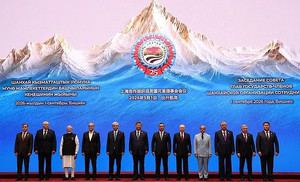
All these trends were fully evident at the SCO leaders’ summit in Kyrgyzstan on August 31–September 1, 2026. Beijing’s dominant position within the Organization was demonstrated by President of the PRC Xi Jinping, who effectively acted as the host of the summit. He was the first among the other heads of state to arrive in Bishkek and greeted them there as if on his own turf. This role was reinforced by practical steps to strengthen China’s position in Central Asia. For example, China and Kyrgyzstan concluded a Treaty on Eternal (Perpetual) Good-Neighborliness, Friendship, and Cooperation, and also signed a Joint Declaration on a Comprehensive Strategic Partnership in the New Era.
The framework agreements are fleshed out in more than 30 bilateral agreements, which provide for the continued construction of the China-Kyrgyzstan-Uzbekistan railway, the construction of a road bridge on the border between China and Kyrgyzstan, the expansion of settlements in national currencies and the integration of Kyrgyz banks into the Chinese CIPS payment system, as well as cooperation in the scientific, educational, and cultural spheres. This can be seen as an example of the development of the legal framework for the process of consolidating China’s position in Central Asia. Its foundations are laid in the Treaty on Everlasting Good-Neighborliness, Friendship, and Cooperation between China and the Countries of Central Asia, which was signed in June 2025 during the second “China–Central Asia” summit (C+C5 format) in Astana. The agreements are based on the concept of the “China-Central Asian spirit” and provide for the comprehensive development of infrastructure, trade, and security, bypassing Russia’s geopolitical influence. In other words, China has demonstratively sidelined Russia in Central Asia, a move defined by the relevant legal and treaty framework and implemented in the political, economic, and cultural spheres. The Russians still have some influence in the region and exercise it at the bilateral level and through the mechanisms of the CIS, the CSTO, and the Eurasian Economic Union. But this influence is waning and becoming increasingly formal.
China also used the SCO summit to advance its geopolitical interests regarding the creation of a multipolar world as a counterweight to the USA’s unilateral dominance. In fact, this was the main focus of Xi Jinping’s speech at the meeting, in which he called on SCO member states to join forces in achieving this goal. It is quite clear that this is about establishing China’s role as a leading center of power, on par with the United States, under the guise of advocating for a multipolar world order. And the SCO is being used by China as a tool to achieve this goal.
Russia, unlike in the past, found itself on the periphery of the summit. This fully confirmed that it has lost its leadership role in the SCO. Such changes are evident even to the Kremlin itself, which hastened to change its attitude to the Organization, viewing it as offering no prospects for itself. Indeed, Putin did not attend the start of the summit. He appeared closer to the middle of the proceedings. At this, it was quite clear that the Russian president’s main goal was to demonstrate his loyalty to China and to meet with Xi Jinping, hoping for his assistance in Russia’s confrontation with the West and in the war against Ukraine. These issues are becoming particularly important for Putin given that Washington is issuing ultimatums demanding a halt to hostilities along the front lines, and that Russia’s economy is nearing the brink of a deep crisis.
However, he miscalculated once again. Xi Jinping did not promise him loans and did not agree to China’s participation in the “Power of Siberia 2” gas pipeline project on Russia’s terms. He even spoke out in favor of restoring peace in Ukraine without any mention of Russia’s interests.
Prime Minister of India N. Modi did the same, calling on Putin more explicitly to end the war against Ukraine. Earlier, President of Kazakhstan K. Tokayev made a similar appeal during his meeting with Putin in Moscow on July 25 of this year. In other words, rather than supporting Russia, leading SCO members have spoken out against its actions regarding Ukraine. In fact, they have joined forces with the USA and Europe to exert pressure on Putin in order to persuade him to pursue peace. Only Iran remains Russia’s sole partner, as was evident during Putin’s meeting with that country’s President M. Pezeshkian.
This development shows that there is no positive way out for Putin, even though he still dreams of defeating Ukraine. Indeed, immediately after the summit in Bishkek concluded, he held a press conference in which he announced his refusal to agree to an unconditional ceasefire and stated that Russia would agree to end the war only on its own terms. He also threatened to launch a massive strike against Ukraine’s energy infrastructure, for which, he said, Russian troops are already preparing.
At the same time, terrorist attacks on Ukraine – and specifically on the capital, Kyiv – were intensified, involving the use of jet “Shaheds”, which were launched continuously for several days. In this way, Putin is trying to force Ukraine to cede at least the entire Donbas region to him, since he evidently no longer hopes to achieve a complete victory. At this, he has extremely little time left, as the country’s economic problems are becoming critical in nature, which will deprive Russia of the ability to continue the war in the manner Russians are accustomed to. However, judging by how the situation is unfolding, he will not be able to achieve his goals and will ultimately lead his country to disaster.
So, Russia continues to lose its global standing, including in the post-Soviet space. At the same time, its influence over international organizations – which were developed and implemented at its initiative to promote Russian interests – is waning.
Leadership in this is steadily shifting to China, which significantly outpaces Russia in terms of economic potential and opportunities for cooperation with its partners. Consequently, these partners give preference to China rather than Russia. This is particularly evident in the Shanghai Cooperation Organization (SCO), which brings together Asian nations. Today, the leading role in the SCO has shifted from Russia to China, allowing China to capitalize on this situation. Indeed, China is using SCO mechanisms to bring Central Asian countries into its sphere of influence and has already significantly sidelined Russia there. Consequently, the SCO has effectively lost its significance for Russia. It does not allow Russia to pursue its own policies, while the Organization’s member states not only fail to support its war against Ukraine but, on the contrary, are trying to pressure Russia with calls to cease hostilities. As a result, Russia finds itself in a vicious circle of both partners and enemies who are trying to force it to make peace.
So far, Russia has resisted this and has even intensified its air war against Ukraine. It hopes to force our country to cede at least the entire Donbas region to Russia. However, it will not succeed with such demands, and it may find itself in a catastrophic situation.
Yurii Mykhailenko,
Institute for Global Politics
Photo source: the Kremlin’s website