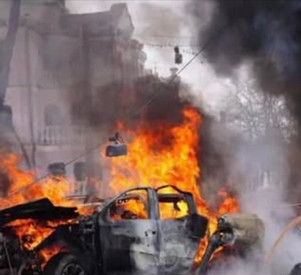
Over the past two weeks, the cities of Sumy and Kryvyi Rih have come under brutal missile attacks
These barbaric assaults by the Russians have claimed the lives of many civilians, and it is especially painful to realise that among the victims of these bombings were very young children.
It has now become clear that Russia is unable to defeat Ukraine on the battlefield, and has therefore resorted to a strategy of attrition and terror. The current military and political leadership of Russia appears to believe that such tactics will force Ukrainians to abandon their struggle and surrender. In reality, however, these atrocities do not instil fear in Ukrainians, but provoke an entirely different response. Under such circumstances, they are determined to continue resisting Russia, even if the entire world were to turn its back on them.
This once again proves that Ukrainians and Russians are not one and the same people. Putin has long ruled Russia through methods of terror and repression, and he assumes that Ukrainians can be subdued in the same way—though this is far from true.
When comparing the mentality of Ukrainians and Russians, it is important to note that the overwhelming majority of the Russian population exhibits a pronounced slave mentality. As is well known, a slave cannot imagine life without a master. They always require someone to make decisions for them and dictate how they should live. At the same time, when the master’s grip weakens, the slave seeks to take their place. This mindset is vividly portrayed in Russian cinema. The most popular characters are noble ‘thieves-in-law’, ruthless yet supposedly just ‘cops’, and bold, lone paratroopers or special forces who mercilessly punish brazen ‘hooligans’. Scenes of violence and the ‘just punishment’ of various scoundrels run like a red thread through all the most popular Russian TV series. In all these stories, there is only one consistently effective method used to achieve the desired result—and it is applied equally by the criminals, the police, and the military: brute force.
In Russian society, a cult of cruelty, violence, and fear prevails in all aspects of life.
In contrast, for Ukrainians, values such as freedom, justice, and independence are truly sacred. It is precisely to avoid being reduced to a state of slavery that they are willing to continue fighting the Russians—even at the cost of their own lives.
At the same time, it is important to note that in the war against Russia, the position of the West holds critical importance for Ukraine. It is clear that relying solely on our own strength to overcome an enemy with vastly greater resources would be extremely difficult. That is why assistance and support from allies and partners is absolutely essential. Moreover, given Russia’s aggressive foreign policy, military-technical and financial support for Ukraine is, for the West, not only necessary but also a highly beneficial investment in their own security. Today, nearly none of the Western leaders harbour any doubts that fighting a war on their own territory would be far more dangerous and costly than providing aid to Ukraine.
When Donald Trump claimed he would end the Russia–Ukraine war within 24 hours of assuming office, it genuinely alarmed Putin—especially the part where the US President promised to supply Ukraine with substantial weaponry if the Russian President refused to sign a peace agreement.
However, after Trump failed to follow through on his words, he was seen by Putin and his circle as all talk—a “loudmouth” who could be dismissed and ignored. From the perspective of the Russian criminal mentality, this was a sign of weakness—and, as is well known, in their world, only power commands respect.
When Trump begins to prioritise commercial interests and speaks of ending the war by negotiating some kind of “deal,” it comes across as unserious, even laughable. What is happening between Russia and Ukraine is a brutal and uncompromising war—one that, for both sides, has become a matter of life and death. Therefore, Trump’s rhetoric holds little to no significance for them.
Now, as for Trump’s position on avoiding further escalation of the Russia–Ukraine conflict due to the threat of nuclear war—his arguments do not hold water. Humanity already stands on the brink of such a war. Even though Ukraine gave up its nuclear arsenal, it still remains, in a sense, a nuclear state. It is obvious to many that Russian missile strikes could damage Ukraine’s nuclear energy facilities, inevitably resulting in radioactive contamination—something that would almost certainly affect not only Ukraine’s population.
It is widely known today that following the Chernobyl disaster in 1986, the radioactive cloud spread far beyond Ukraine, Belarus, and Russia—reaching as far as the borders of Sweden and Canada.
On the other hand, no one can guarantee that Ukraine’s Armed Forces will refrain from striking nuclear facilities in the Russian Federation. And for this, they do not necessarily require Western weaponry. Ukraine now possesses sufficient capabilities, as well as the experience gained over years of this brutal and bloody war, to carry out such operations independently.
Against the backdrop of Donald Trump’s entirely inappropriate “commercial” rhetoric—which, under current circumstances, Putin no longer pays any attention to—the position of Friedrich Merz, the current leader of Germany’s Christian Democrats, appears far more measured and pragmatic. Merz has stated that the only way to save Europe from war is by providing Ukraine with effective support and ensuring its victory over Russia.
Unlike the United States and Donald Trump—who are separated from Russia by an ocean—Friedrich Merz fully understands the potential danger that the Russia–Ukraine war poses to Germany and the whole of Europe. It can be said that Germany, given its scientific, technological, financial, and economic potential—as well as its strategic geopolitical position—is today Ukraine’s most natural and interested ally in the war it has been waging for four years in defence of its independence and freedom.
We can therefore hope that the German government will continue to support Ukraine in its just struggle, as this will contribute to the establishment of lasting peace in Europe and serve as a wise investment in both Germany’s own security and that of the entire European Union.
Oleh Bereziuk,
Institute of Global Policy