Will America Remain its Guarantor?
Despite the peace talks, Russia continues to launch massive strikes against Ukraine, showing that its goals for our country remain unchanged;
if Moscow achieves its goals, its military expansion on the European direction will continue. In this case, the support of the United States is of fundamental importance for Europe;
so far, the United States does not plan to significantly reduce its troops in the European theater of operations. However, they may do so if China’s military threats in the Asia-Pacific region increase;
such US actions will weaken NATO and reduce Europe’s ability to counter Russia, which will have negative consequences for Ukraine. At the same time, the role and importance of our country in the European security system will increase.
Russia’s latest massive air strikes against Ukraine, despite the peace talks, once again demonstrate the aggressive nature of the Putin regime and its intentions to achieve its goals at any cost.
It is well known why Russia attacked Ukraine, including Kyiv, using a record number of strike weapons. But one way or another, under pressure from the United States and Europe, it will have to engage in a real dialog with Ukraine. Moreover, due to the critical deterioration of its economy, Russia is increasingly losing its ability to continue the war. That is why Moscow is using all its capabilities to inflict maximum damage on Ukraine and force it to surrender. But Russia is unlikely to be able to achieve its goals by relying on successes at the front, which is why it is resorting to terrorist actions.
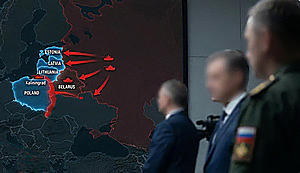
However, Russia’s global plans are not limited to Ukraine, they are more extensive in nature. As before, it intends to restore the sphere of influence of the former USSR, which covered the entire Central and Eastern Europe and the Baltic States. Currently, Russia is not able to achieve this, but in case of a victory over Ukraine, it will certainly begin preparations for further military aggression on the European direction.
The leaderships of NATO, the EU, and most European countries are well aware of these threats. That is why they are taking measures to develop and strengthen European and Euro-Atlantic security systems. At this, Ukraine is expected to be included in them, since it has the most powerful army in Europe with real combat experience and motivation in confronting Russia.
At the same time, the level of threats to the United States from China is growing significantly. This is forcing Washington to pay less attention to Europe and limit the resources intended for its defense. It is this situation, and not D. Trump’s neglect of such US commitments, that is the real reason for his position on shifting more responsibility for Europe’s security to Europe. This is the main essence of the new European security architecture.
However, according to European experts, Europe without the United States, even with Ukraine’s participation, will not be able to deter Russian aggressors on its own. To be honest, it’s hard to agree with this, but Europeans are well aware of their capabilities. Therefore, the question remains: will the United States leave Europe or not, and what should Europe do in case of the USA’s withdrawal? This directly relates to the US membership in NATO and the continued US military presence in Europe. After all, a number of politicians and experts argue that Washington is already implementing such intentions. It is worth considering this issue in more detail, taking into account the experience of D. Trump’s previous presidential cadence in 2017–2021.
 Thus, according to objective realities, the United States’ withdrawal from NATO is unlikely in the near future. According to the repeated statements of US President D. Trump and Secretary of State M. Rubio, Washington remains committed to NATO and supports Article 5 of the North Atlantic Treaty on Collective Defense. This is true, as none of the US officials has officially raised the issue of the USA’s withdrawal from the Alliance. Such a possibility is mentioned only in a hypothetical plane as a distant prospect, while the assumptions of some media and experts about such United States’ intentions are groundless. The plans to build a new European security architecture do not envisage a radical restructuring of NATO or creation of a separate army with the simultaneous the United States’ withdrawal from European defense. At this stage, only some adjustments are planned to the subordination of NATO’s governing bodies in Europe and their structure and tasks. In particular, this may include the appointment of EU representatives to head such bodies and an increase in the share of Europeans among the staff. Besides, the EU will provide logistics for NATO troops in Europe. This has already been discussed in more detail in our publications.
The United States’ commitment to its obligations to Europe, despite changes in the situation, is also confirmed by D. Trump’s actions during his previous presidential term. At that time, he also admitted the possibility of the USA’s withdrawing from NATO or reducing its military presence in Europe, but not only he did not do so, but, on the contrary, strengthened such a presence.
When he first came to power in the United States in 2017, he advocated the need to transfer more responsibility for European security to Europe, which would allow America to reduce its own military spending. He also hoped to improve relations between the United States and Russia, which had become significantly more complicated as a result of Moscow’s attack on Ukraine in 2014.
As you know, D. Trump’s hopes for improving US-Russian relations did not come true, and as a result, he refused to withdraw from NATO or reduce US troops in Europe. On the contrary, he began to build them up. Moreover, this process has reached a qualitatively new level.
In particular, in 2020, D. Trump and his Polish counterpart A. Duda signed an agreement to change the principle of deployment of US troops on Polish territory from rotational to permanent. According to the document, the number of US troops in Poland was increased by a thousand people –to 5,500 soldiers and officers. Besides, an agreement was reached on the location of six American bases in Poland. On the basis of this and other agreements, the restoration of the 5th Army Corps of the US Armed Forces, which had been stationed in Germany since World War II and was disbanded in 2013, began. Currently, the Corps includes two rotational divisions, a separate armored cavalry regiment (actually a mechanized brigade), an artillery brigade, and an army aviation brigade. The corps’ headquarters is located in Poland. One of the divisions is on Polish territory, the other in Romania, and the brigades are in Germany.
The 5th AC is comparable in strength to the Combined Arms Army of the Russian Armed Forces and is the backbone of the US Army in Europe. The Corps is subordinated to the US Army Command in Europe and Africa. The Command also includes the 7th Army Training Command, the Southern European Task Force – Africa (includes an airborne brigade), the 56th Artillery Command (in fact, a missile brigade), the 10th Missile and Air Defense Command, and the 21st Support Command.
In case of full deployment of the Command with the addition of another army corps, it would correspond to a front or a group of troops (two or three armies) of the RF Armed Forces. Along with this, the US Armed Forces in Europe include the US Air Force Command in Europe and Africa, which includes the 3rd Air Force and the Navy Command (formerly the Atlantic Fleet). All this is united under the control of the US European Command (EC).
 Depending on the situation, the US Armed Forces in Europe can be strengthened or reduced. For example, in case of an escalation of the confrontation between Russia and the West, the United States may deploy another army corps in Europe, as it did during the Cold War. The combat capabilities of the US Air Force and Navy in the European and Atlantic zones will also be enhanced. The same will be done in case of a real threat of war between Russia and the United States/NATO, but in a shorter time frame.
If the confrontation between Russia and the West remains at the current level or weakens, and the threats to the United States from China, on the contrary, increase, Washington may reorient some of its troops from the European and Asia-Pacific theaters. In this situation, the US military presence in Europe will be reduced.
Thus, the tasks and structure of the European Command (EC) of the US Armed Forces will be revised, which will be limited to performing only the most important functions. The main ones will be to confirm NATO’s unity and to participate in deterring Russia by maintaining the US military presence in Europe at the required level.
Another function of the US Army’s EC will be to maintain the readiness of US troops to act in the European theater of operations in cooperation with European allies. In addition, the Command will ensure the possibility of a rapid build-up of the US Armed Forces in Europe in a threatening period by redeploying US troops from the continental United States.
All this implies the presence in Europe of the relevant elements of the US Armed Forces, including: command structures; command and control systems; combat formations and units; air defense systems; logistics bodies; warehouses with weapons and military equipment for units that will be redeployed to the European theater of operations in a threatening period; infrastructure for deployment of troops.
At the same time, taking into account the experience of reducing the US military presence in Europe after the end of the Cold War, the following structures have been determined: headquarters structures of the US Army, Air Force and Navy commands in Europe and Africa; combat formations and units; logistics and support units.
The headquarters, command and control bodies, units and subunits, as well as other structures to be downsized in Europe, may be transferred to the United States, retained in place as storage bases for weapons and military equipment, or completely eliminated.
Simultaneously with preparations for a possible reduction of the US military presence in Europe, measures will be taken to bring the structure and system of deployment of US troops in Europe in line with the new situation. Currently, some of these measures are underway, but they are not considered the beginning of the withdrawal of the US Armed Forces from Europe.
At the same time, it is not the withdrawal of some US troops from Europe that is really important, but the preservation of the possibility of their operational reinforcement and return to the European theater of operations in case they are redeployed to other locations.
For example, Europe is critically dependent on the United States only in strategic deterrence of Russia, as the nuclear potential of France and the United Kingdom is much smaller than that of Russia. According to various estimates, the total contribution of the United States to NATO in the field of conventional forces is 15–16 %. Sometimes the figure of 30 % is published, but most experts refute it. At the same time, in peacetime, a relatively small number of US military units are stationed in Europe, which are not of fundamental importance. In particular, today they are three times smaller than the Polish Armed Forces. That is why the main thing is the USA’s ability to build up its troops in the European theater of operations, which can be increased several times to the level of the past Cold War.
The fulfillment of this task in Europe is entrusted to the relevant US and NATO transport and logistics structures. Based on this, one of the main indicators of the USA’s intentions to actually leave Europe will be their reduction.
 Plans to reduce the US military presence in Europe will certainly be reflected in the system of operational and combat training of the US and NATO forces in the European theater of operations. So far, no such changes have been observed. The US and NATO forces’ operations and training activities are taking place according to previously approved plans. A standard set of tasks is fulfilled to prepare the United States and NATO to repulse Russia’s possible aggression. This is evidenced by the “Defender Europe – 2025” SCPE of the US Armed Forces and Joint Armed Forces of NATO in the European theater. The US Armed Forces participate in it in full.
The possible reduction of the US military presence is rather ambiguous for Ukraine. Yes, it will objectively weaken NATO in Europe and reduce its support for Ukraine in its confrontation with Russia. At the same time, it will increase the role and importance of our country for Europe as one of the main forces in deterring Moscow. This will facilitate Ukraine’s inclusion in the European security system. At the same time, the prospects for the withdrawal of US troops from Europe, even if they are hypothetical, can be used by Ukraine to promote its initiative to partially replace them with units of the Armed Forces of Ukraine in the postwar period.
All this allows us to draw several conclusions about Ukraine’s interests. Thus, despite the problems in US – Russian relations, the United States remains committed to its security commitments to Europe. In view of this, in the short and medium term, the United States will not withdraw from NATO and will not significantly reduce its military presence in the European theater. Therefore, NATO will maintain its unity and ability to confront Russia and support Ukraine in this matter.
However, even if the United States is forced to redeploy some of its troops from Europe to the Asia-Pacific theater to counter China, it will be able to quickly return them if necessary. At the same time, the reduction of the US Armed Forces in the European Threatre will be a factor that will increase the role and importance of Ukraine in the European security system.
Yurii Ilchenko,
Institute for Global Politics