«The Shadow of Victory» or “The Phantom of Victory”
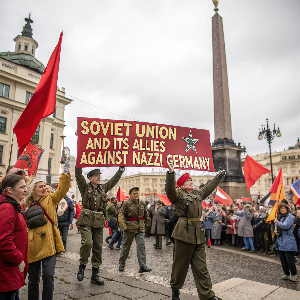
Moscow has traditionally used Victory Day over Nazi Germany as an occasion to demonstrate Russia’s role as a “great world power” and “successor to the USSR”;
this is especially important for Moscow now in connection with the 80th anniversary of the event. At the same time, within the framework of its overall plans, it is trying to disguise the failure of the strategic goals of the so-called “SVO” (“Special Military Operation”– Transl.);
However, as before, Russia’s attempts are failing. It remains a pariah for the Western world and attracts only China, as the latter’s de facto colony, and own satellites;
At the same time, Moscow’s attempts to actualize accusing Ukraine of Nazism have also failed, as shown by our country’s being invited to V–Day in Europe celebration on May 8 in London.
Since the collapse of the Soviet Union, one of the main themes of Russian propaganda has been to impose the myth of Russia’s decisive role in the victory over Nazi Germany during World War II. And this is not just a glorification of the Russian Federation and a play on the feelings of ordinary Russians who have always considered themselves the “chosen nation”. This is how the Russian ideology is justified, which defines Russia as a “great world power” – “the successor to the Soviet Union”. And now it is also justifying Russia’s war against Ukraine, saying that it is an “ongoing struggle against Nazism”.
This year, the Kremlin attaches special importance to this issue. This is due to the formation of a new myth about “Russia’s victory over Ukraine” to cover up Moscow’s inability to achieve its strategic goals, as well as the urgent need to end the war as soon as possible due to the worsening problems in the Russian economy. At this, Ukraine is presented as an analog of Germany, and the alleged victory over it is seen as akin to the surrender of the Hitler regime in 1945. The 80th anniversary of this event is used to make such analogies more pronounced. In addition, the Kremlin hopes to demonstrate that it is supported by its allies and partners, the main one being China. It is on China, as the world’s leading power, that Russia relies in its confrontation with the West. Besides, representatives of many other countries are invited to Moscow to celebrate the next Victory Day anniversary, including the United States, which is currently considered to be almost a supporter of the Kremlin.
However, no matter how hard Russia tries to take over the role and importance of the former USSR in the world, it is only its pale shadow, and its “victory” over Ukraine is a phantom of the real victory of the Soviet Union and its allies in the anti-Hitler coalition over Nazi Germany. By the way, they are the main adversaries of Putin’s Russia today. There is no need to prove this, because everything is clear without words. But some people, including some people in Ukraine, really perceive today’s Russia on a par with the USSR, which is a consequence of its information influence and sometimes of lack of knowledge of history. Therefore, it is probably necessary to raise this topic.
So, whatever one may say about the USSR, it was indeed a great world power. I’m not praising it, I’m just stating a fact. And it became so as one of the winners in World War II. It was the main members of the anti-Hitler coalition who divided the postwar world among themselves. As you know, this happened at the Yalta Conference in February 1945. According to its decisions, Eastern Europe was added to the sphere of influence of the Soviet Union. Together they created the Soviet or Eastern Bloc. Western Europe was assigned to the USA. Together, they formed the Western bloc. Later, the USSR and the United States de facto divided most of the rest of the world, including the Middle East, Africa, and, to some extent, the Asia-Pacific Region. At the same time, their confrontation led to the Cold War and conflicts in those regions, which were caused by both sides. And in 1962, the Cuban Missile Crisis almost led to the outbreak of World War III, during which nuclear weapons could have been used. However, the parties managed to reach a compromise and continued to coexist relatively peacefully.
All this was made possible by the identity of the USSR and the US potentials, which forced each to take into account the interests of the opponent, including when dividing the world. Moreover, this concerned not individual indicators, but their overall capabilities and role in the world.
For example, the GDP of the Soviet Union averaged about 40% of the GDP of the United States. The standard of living of the Soviet population and the social sphere was also much lower. The USSR also lagged behind the United States in terms of technology and a number of other parameters.
At the same time, the Soviet Union was a powerful and completely self-sufficient state. In terms of GDP, it ranked second in the world, could produce the full range of major industrial and agricultural products, and its space, aviation, energy, and other industries were as good as those of the United States. Since the 1970s, the USSR had become the largest supplier of oil and gas to Europe, which had become dependent on it in the energy and, to some extent, political spheres.
The same was true of the USSR’s armed forces and military-industrial complex, which were the largest in the world, surpassing even the United States. In particular, in the 1980s, the Soviet Army and Navy numbered 4.2 million people, while the US Army and Navy numbered 2.5 million. The armed forces of the entire Soviet bloc or Warsaw Pact reached 6.5 million people, while NATO’s was 5 million. The USSR and its allies also had a similar advantage in the main types of conventional weapons, and in terms of nuclear potential, it had parity with the United States.
That was the basis for the Soviet Union’s international authority, which was not lower than that of the United States. That is why both countries occupied the same position in the overall system of international relations in the world and, in fact, decided its fate with little participation of other states. There was also the Third World, consisting of countries that did not join either the Eastern or Western blocs. But at that time, their role was rather modest and they avoided interfering in resolving global international problems. This was the position of China, even though it was a member of the UN Security Council due to the fact that it had nuclear weapons.
Of course, the USSR also had many internal problems that resulted from the inadequacies of its communist system and its inability to compete with the capitalist systems of the United States and other Western countries. As a result, the Soviet Union lost the Cold War and fell apart into parts began to develop independently. Russia was one of them, but it suddenly declared itself the successor to the Soviet Union. However, as already mentioned, compared to the USSR, the current Russian Federation looks like its pale shadow.
Let’s start with the economy, which is the basis for everything else. In 2024, Russia’s gross domestic product was only 7 % of the USA’s GDP. Although, this is most likely an exaggeration of Russian propaganda. Thus, even in the best case scenario, the alleged GDP growth of the Russian Federation was achieved only due to an increase in military production and does not reflect the real economic situation in the country. Moreover, Russia has completely lost its economic sovereignty. It is currently unable to produce any type of high-tech equipment on its own, including airplanes, ships, cars, machine tools and equipment, electronics, etc. All of this is provided to Russia by more developed countries or is obtained through joint production. First of all, we mean China. It dominates the Russian market. What can we say about anything worthwhile if China supplies Russia even with nails, not to mention all other goods, from electronics to machinery and various equipment and textiles.
At the same time, Russia has lost its role as a leading producer of oil and gas, with which it used to supply Europe. And it lost it without any external interference. As a result of Russia’s gas wars against Ukraine and Europe in the 2000s, the EU began to give up such Russian supplies. And in response to Russia’s full-scale war against Ukraine in 2022, the European Union practically gave up its pipeline supplies. The same thing actually happened with Russian oil. As a result, Russia has not only lost a significant portion of its export revenues and influence in Europe, but has also been unable to reorient its oil and gas supplies to China and other Asia-Pacific countries.
Russia’s military-industrial complex is in a similar state. Its enterprises can produce only small arms on their own, without foreign components, and even this is doubtful, since high-precision machine tools for them are also supplied from other countries. Aircrafts, missiles, UAVs, electronic equipment and other sophisticated equipment are at least one-third foreign-made. Currently, Russia buys them from Iran and China or somehow obtains them bypassing Western sanctions, which makes it impossible to produce the weapons it needs in sufficient quantities.
It cannot manufacture armored vehicles even with foreign assistance. Russia can only restore the samples it had left in storage bases after the collapse of the USSR. It can also repair those damaged at the front. But they are not enough even to meet the minimum needs of troops on the battlefield. As well as the shells that Moscow has begun to import from North Korea. Putin himself acknowledged the lack of strike weapons, which confirms the crisis nature of the situation in this sphere.
This situation has a negative impact on the combat capabilities of the Russian armed forces, which were previously considered “second in the world”. However, Putin’s war against Ukraine has revealed the true situation. For more than three years of the war, Russia has not been able to achieve any of the strategic goals of the “special military operation”, and capturing the relatively small Ukrainian territories was done at the cost of extremely high casualties. Not only did the Russian Armed Forces lose most of their armored vehicles, artillery, and heavy air defense systems, but they also suffered a severe shortage of human resources.
As a result, Russia maintains parity with the United States and NATO only in terms of nuclear weapons. With its conventional forces, it can only frighten the West, which is no longer afraid of it. What should it be afraid of after what happened to the Russian army in Ukraine?
Russia’s international position is equally helpless. Back in 2014, after the first attack on Ukraine, it was expelled from the G8, and then the majority of other countries turned their backs on it. And the International Court of Justice’s opening of a criminal case against Putin and the issuance of an arrest warrant for him have put Russia on a par with rogue states. It seems to still have partners who support it in its war with Ukraine and in its confrontation with the West. The main one is China, which is indeed the world’s leading power, and which has been lending a helping hand to Russia. As has just been mentioned, it is China that the Russian economy is tied to, and thanks to it, it is somehow surviving. But this makes Russia completely dependent on China, putting it in the position of a Chinese satellite with limited sovereignty.
Other partners are pariahs like Russia itself, such as Iran, North Korea, and Belarus, as well as minor countries in Africa and the rest of the Third World. But Russia is losing them too, as in case with Syria.
In this context, the list of foreign leaders who have agreed to travel to Moscow to celebrate Victory Day is illustrative. The main one is President of the PRC Xi Jinping, who looks like a lord who has come to his vassal to “check the situation on the ground» and give instructions for the future. And the Chinese military unit participating in the parade resembles an advanced unit of the occupying army during reconnaissance before a full-scale invasion.
President Lukashenko of Belarus is a vassal of Putin himself, and his armed forces are part of the Russian army. So, it was impossible to do without him. Armenia, Abkhazia, and South Ossetia are in the same position. Everything is also clear with Kazakhstan, Uzbekistan, Tajikistan, Kyrgyzstan, and Serbia. All of them need something from Russia, and so they are forced to show loyalty to it. Among them is Slovak Prime Minister R. Fico, who is a common traitor and collaborator.
But it is difficult to understand what Azerbaijan is doing in Moscow, especially since it is at war with Armenia. At the same time, Azerbaijan’s military servicemen will be at the parade, but for some reason there will be no representatives from Armenia. Apparently, they are ashamed of the lost war in Nagorno-Karabakh, where Russia did not provide assistance to Armenia, although it was supposed to in accordance with its obligations under the CSTO.
The presence in Moscow of the leaders of Cuba, Vietnam, Brazil, Myanmar, Indonesia, Venezuela, and Burkina Faso, who had nothing to do with the Soviet victory over Germany, is completely contrary to normal logic.
Against this background, Western countries are celebrating the 80th anniversary of the Victory in Europe on May 8 in London. A unit of the Armed Forces of Ukraine takes part in the parade. According to the UK Ministry of Defense, this shows that Ukraine is now at the forefront of the fight for freedom. This completely negates all of Russia’s claims about the alleged “Nazi Ukraine”.
So much for Russia’s “victory” and its role and importance in the world as a “great world power”, which is nothing more than a Russian propaganda invention. Of course, Moscow is still capable of continuing the war and will do so in order to seize as much of Ukraine’s territory as possible and force it to agree to Russian terms of peace. But the US President has already demonstrated his willingness to destroy Russia’s economy if it does not agree to a ceasefire and then to a comprehensive and just peace. Let us hope for such prospects.
These are the main conclusions from the article that directly affect the interests of our country.
P.S. Russia compares Ukraine to Hitler’s Germany, and the alleged victory over our country to the Soviet victory in World War II. Okay, let’s agree with this, but let’s imagine a situation where Stalin humiliatingly asks Hitler for an armistice on November 7, 1941, in order to safely hold a parade on Red Square in Moscow. At this, the USSR being a satellite of some third country, just as today’s Russia is a vassal of China.
Could the Soviet Union then claim to be a great world power? Of course not. But for some reason, Russia claims and tries to assure everyone that it has this right. And for some reason, someone is trying to believe it. At the moment, it’s like believing in ghosts or phantoms, which is what the Russian Federation is.
Yuriy Ilchenko
Institute for Global Politics